Weave, Centre for Integrative Psychiatry offers couples therapy and marriage counselling in Kanjurmarg West, Mumbai, and online across India, with Dr. Niharika Reddy, Consultant Psychiatrist and certified couples therapist.Her approach is EFFT (emotionally focused family therapy).A couples session at Weave lasts 30 minutes and costs INR 3,000.The first session meets the couple together and each partner alone, so each person can speak freely.Dr. Niharika Reddy, Consultant Psychiatrist, and Dr. Wilfred D'souza, Consultant Psychiatrist, work as one team.When one partner's low mood, anxiety, ADHD, sleep or drinking is part of the strain, either of them can treat that alongside the couples work.The couple sets the goals, and progress is reviewed together rather than promised in advance.Where there is fear, threats or violence at home, each partner is seen alone first, and safety comes before any joint session.Anyone in danger needs help the same day: call 112 if life is at risk now, or AASRA on 022 2754 6669.
Couples therapy and marriage counselling in Mumbai
Weave, Centre for Integrative Psychiatry offers couples therapy in Mumbai and online with Dr. Niharika Reddy, a certified couples therapist, for partners who keep fighting, drift apart or face a hard decision.
- Psychiatry and therapy
- One working day
- English, Hindi, Kannada, Konkani
- Runwal Forests Clinic, 1:30 to 3 PM
In short
Where can we get couples therapy in Mumbai?
Reviewed by Dr. Niharika Reddy, Consultant Psychiatrist, and Dr. Wilfred D'souza, Consultant Psychiatrist, on 6 November 2026.
What it is, plainly
What is couples therapy, and what is it not?
Couples therapy is a guided conversation about the pattern between two people. It is not a verdict on who is right.
Constant fighting
The same argument can return in new clothes. Sessions look at the loop both partners get caught in, not at who started it.
Distance and silence
Some couples stop fighting and stop talking too. Sessions make room to say what has gone unsaid, at a pace both can manage.
Trust after an affair
Each partner can speak about what happened and what they need. Whether and how to rebuild is decided by the couple.
In-laws and money
Everyday problems, money, children and in-laws are common sources of strain for couples in India.
Before a wedding
Couples can come before marriage to talk through expectations, families and money while things are calm.
Thinking of separating
Sessions can help a couple think clearly about staying or parting. The choice stays with the two of them.
The pattern is the focus, not blame.
Between sessions
What changes from week to week?
Most of the work happens at home, in small steps agreed in the room.
Small tasks to try
- one calm conversation at a time you both choose
- noticing the moment an argument starts to turn
- one way to reach out after a hard day
What to notice
- when the old loop starts, and what set it off
- what each partner felt underneath
- what helped, even a little
What to bring back
- what worked, and what did not
- anything that felt unfair or unsafe
- what each partner wants to work on next
Who runs the sessions
Who runs the sessions, and who is seen alone?
Couples sessions
Dr. Niharika Reddy, Consultant Psychiatrist and certified couples therapist, runs every couples session at Weave.
Individual care for either partner
Dr. Wilfred D'souza, Consultant Psychiatrist, or Dr. Niharika Reddy can see a partner one to one when that partner's own difficulty needs care.
Together and apart
The first session meets the couple together and each partner alone. Later sessions are usually joint, with time alone when it helps.
Someone already in care at Weave
If one partner already sees a Weave psychiatrist, that care continues, and the couple can still be seen with consent.
Fees for therapy
The therapy cost page sets out fees for each kind of session.
Women's mental health
The women's mental health page covers mood and sleep across life stages.
Men's mental health
The men's mental health guide covers stress, low mood and asking for help.
Strain before periods
The PMDD page covers mood changes before periods that can touch a relationship.
ADHD in adults
The adult ADHD guide covers attention, memory and planning in daily life.
The Mumbai clinic
The Mumbai clinic page has directions and timings.
How it works
How do couples sessions work at Weave?
Four steps cover most of what happens, and the couple sets the pace.
A first message
Either partner can send a short WhatsApp message. Nothing needs to be explained in it.
The first session
A 30-minute session that meets the couple together and each partner alone. Safety at home is asked about with each partner.
Goals you set
The couple names what they want to change. Nothing is decided before both partners' questions are answered.
A short course, reviewed
Sessions follow at a pace that suits the couple. Progress is reviewed together, and no set number of sessions is promised.
Is there a test that shows whether a relationship will last?
No questionnaire decides a relationship, so conversation comes first.
Online quizzes
A quiz score cannot say whether a marriage is over. Only the two people in it can decide that.
Questionnaires in sessions
A short questionnaire may be used to track change over time. It informs the work and never decides it.
What helps instead
Hearing each partner, together and alone, shows the pattern more clearly than any score.
Worth a second look
When is one partner's difficulty part of the strain?
Sometimes a problem that sits with one partner shapes the whole relationship, and it needs care in its own right.
When a mental health problem is the untreated piece
When a partner joins treatment for a mental health problem, couple-based work can help that problem and the relationship too. The adult ADHD guide explains one common example.
First, or alongside?
Whether a partner's own care starts first or runs alongside the couples work is a clinical judgement, made with the couple.
One partner's care can help both.
Distance and time
What if we live apart or work long hours?
Sessions can be arranged around distance, shifts and busy weeks.
Partners who live apart
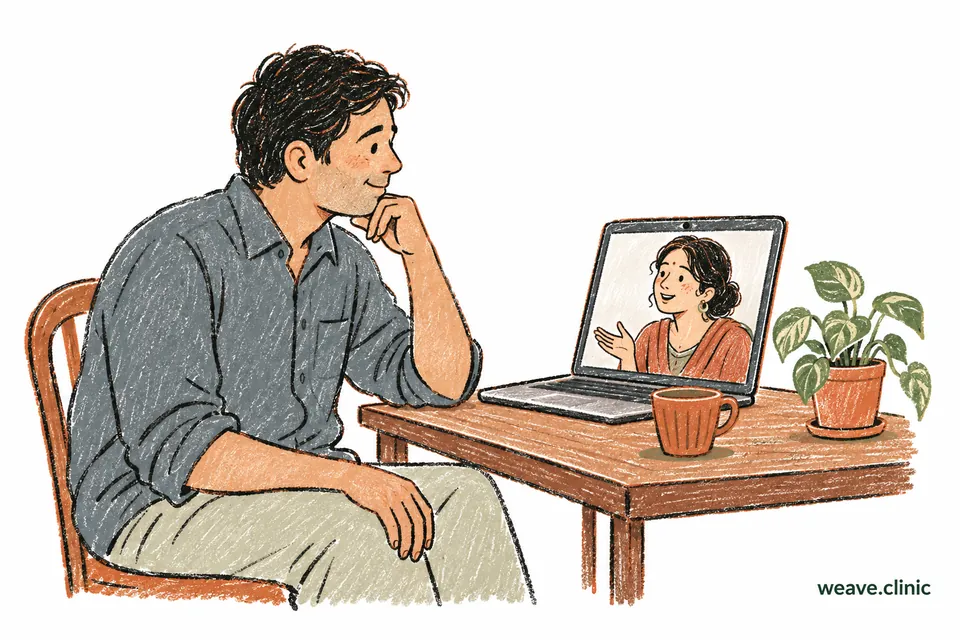
Online sessions run by video across India, by appointment, so partners in different cities can join from where they are.
One in the clinic, one online
One partner can come to the clinic in Kanjurmarg West while the other joins by video, when that suits the couple.
Shifts and busy weeks
Sessions are 30 minutes and booked ahead, so they can fit around work.
Plain facts for online sessions
A private space
Each partner needs a room where they cannot be overheard, most of all for time alone.
Languages
Sessions can be held in English, Hindi, Kannada or Konkani.
Safety online
If a partner cannot speak freely at home, say so in the first message, and another way is found.
Evidence and follow-up
What does the evidence say about couples therapy?
Couples therapy has research behind it, and the research also shows its limits.
What trials show
Emotionally focused and behavioural couples therapy both gave a medium gain in relationship satisfaction soon after therapy, with no clear difference between them.
Gains were smaller by six months, so practice between sessions matters.
When a partner has a mental health problem
When a partner joins treatment for a mental health problem, couple-based work did at least as well as individual CBT and also helped the relationship.
How Weave uses this
Dr. Niharika Reddy uses EFFT, one approach among several with research support.
The couple's goals guide the work, and progress is reviewed together.
If there is violence, fear or control at home, each partner is seen alone and joint sessions start only if safe. Anyone in danger needs help the same day: call 112 if life is at risk now, or AASRA on 022 2754 6669.
Crisis lines are listed in the crisis support section of this page. Weave is not an emergency service. We reply within one working day.
The plan follows what the couple learns.
Before you come
Practical details
Sessions happen at the clinic in Kanjurmarg West or online. The Mumbai clinic page has directions.
Clinic and hours
Runwal Forests Clinic, Ground Floor, Tower 5, Runwal Forests, Kanjurmarg West, Mumbai. Open 1:30 PM to 3:00 PM, all days including Sunday.
Online
Online consultations across India, by appointment.
Bring and read
A few words on what each partner hopes will change and a medicine list; the medication questions and rights page.
Registration
Dr. Niharika Reddy is registered with the Maharashtra Medical Council, registration number 2026801900. Dr. Wilfred D'souza is registered with the Maharashtra Medical Council, registration number 2021/11/8266.
Evidence, plainly
Does couples therapy work, and for whom?
The research is encouraging but modest, and a plan should say what it can and cannot offer.
How large are the gains?
A pooled analysis of 33 trials found a medium gain in relationship satisfaction soon after therapy.
Do the gains last?
Gains were smaller at six months, and the authors noted that some studies may be missing from the record.
Is one approach better than another?
Emotionally focused and behavioural couples therapy did about as well as each other in that analysis.
What if there is violence at home?
Couples work is not a first step where there is violence. Each partner is assessed alone and safety comes first.
What about couples in India?
An Indian study found everyday problems, money, children and in-laws to be common sources of conflict. Larger Indian data are still limited.
Cost, stated plainly
Fees by appointment
The fees below are set by appointment type and length; the therapy cost page explains what each appointment includes.
| Appointment | Length | Fee |
|---|---|---|
| Session | 20 minutes | INR 2,200 |
| Session | 30 minutes | INR 3,000 |
| Couples session | 30 minutes | INR 3,000 |
Common questions
Questions people ask before booking
Does couples therapy work?
Trials show a medium gain in how satisfied couples feel soon after therapy, with smaller gains by six months. Practice between sessions matters. No clinician can promise how a particular relationship will turn out.
Do we come together or alone first?
Usually both. The first session meets the couple together and each partner alone, so each person can speak freely. Where there is fear or violence at home, each partner is seen alone first.
What if my partner will not come?
One partner can start alone. Individual sessions can look at your side of the pattern, what you want, and how to invite your partner later. The door stays open if they decide to join.
Is this for married couples only?
No. Couples who are dating, engaged, living together or married can all come. Couples planning a wedding can also come to talk through expectations, families and money before things get hard.
Can we do sessions online?
Yes. Sessions run by video across India, by appointment, which helps when partners live in different cities or work long hours. Each partner needs a private space where they cannot be overheard.
Does one of us need a psychiatrist first?
Not as a rule. When low mood, anxiety, ADHD, sleep or drinking is part of the strain, a psychiatrist can treat it alongside the couples work. Whether that care starts first is decided with the couple.
What if I am afraid of my partner?
Your safety comes first. Each partner is seen alone first, and joint sessions start only if they are safe. Anyone in danger needs help the same day: call 112 if life is at risk now, or AASRA on 022 2754 6669.
Ring the doorbell
A sentence or two is enough
A first WhatsApp message can be one line from either partner, and it does not need to explain what is happening.