Paper I
Brain, Mind and Method
326 pages · 100 answer maps · 179 illustrations
Choose this paper in the original editionTheory revision, in two editions
and Weave 100+
Four hundred answer maps across Papers I to IV. Choose the compact originals or the illustrated books, with the same maps and selected images alongside them.
Preparing for the practical? Explore Weave Viva.
The illustrated theory set
The four Clinic-cover books, with original answer maps and 633 illustrations. Screen files are smaller; print files retain the fuller artwork payload.
Paper I
326 pages · 100 answer maps · 179 illustrations
Choose this paper in the original edition
Paper II
283 pages · 100 answer maps · 134 illustrations
Choose this paper in the original edition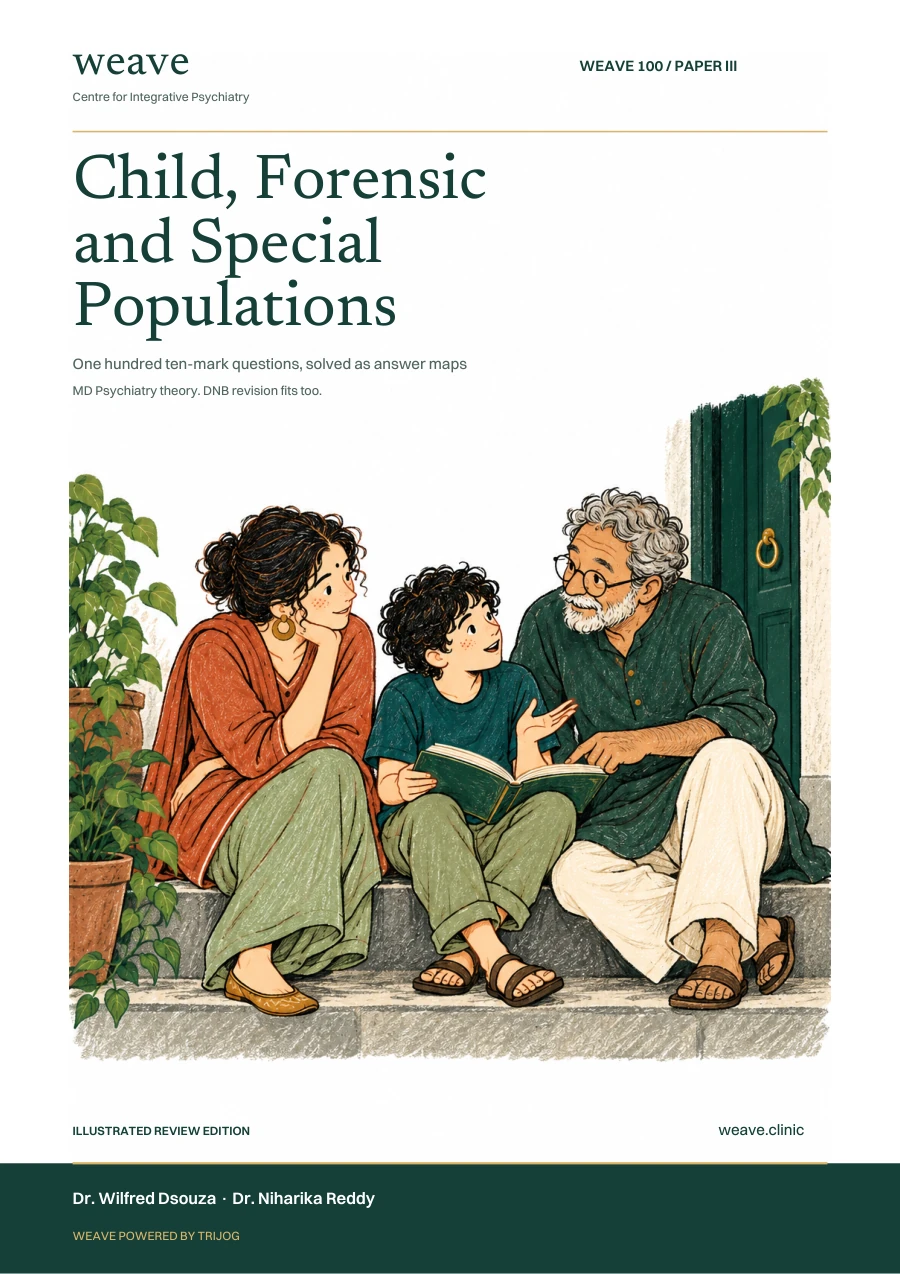
Paper III
331 pages · 100 answer maps · 181 illustrations
Choose this paper in the original edition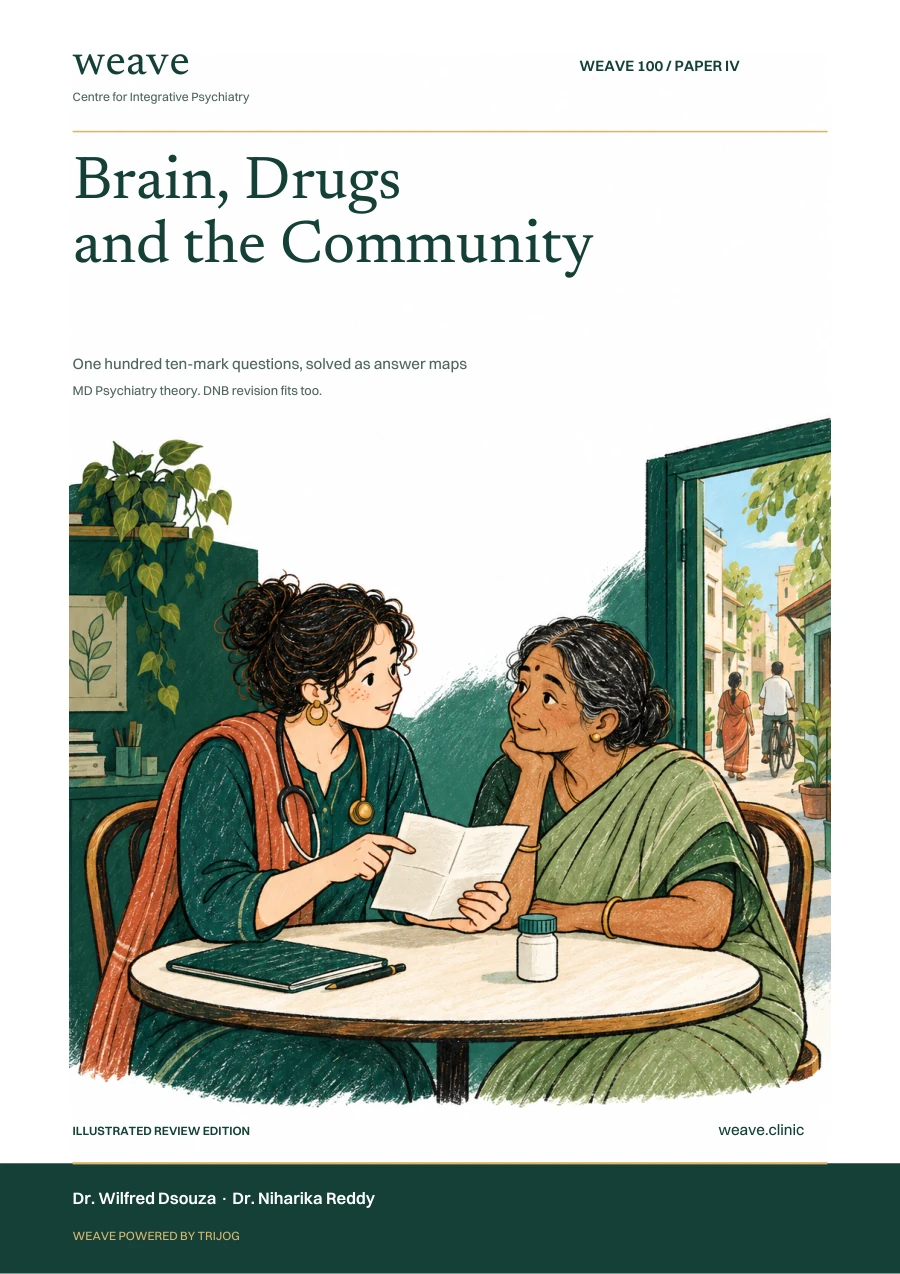
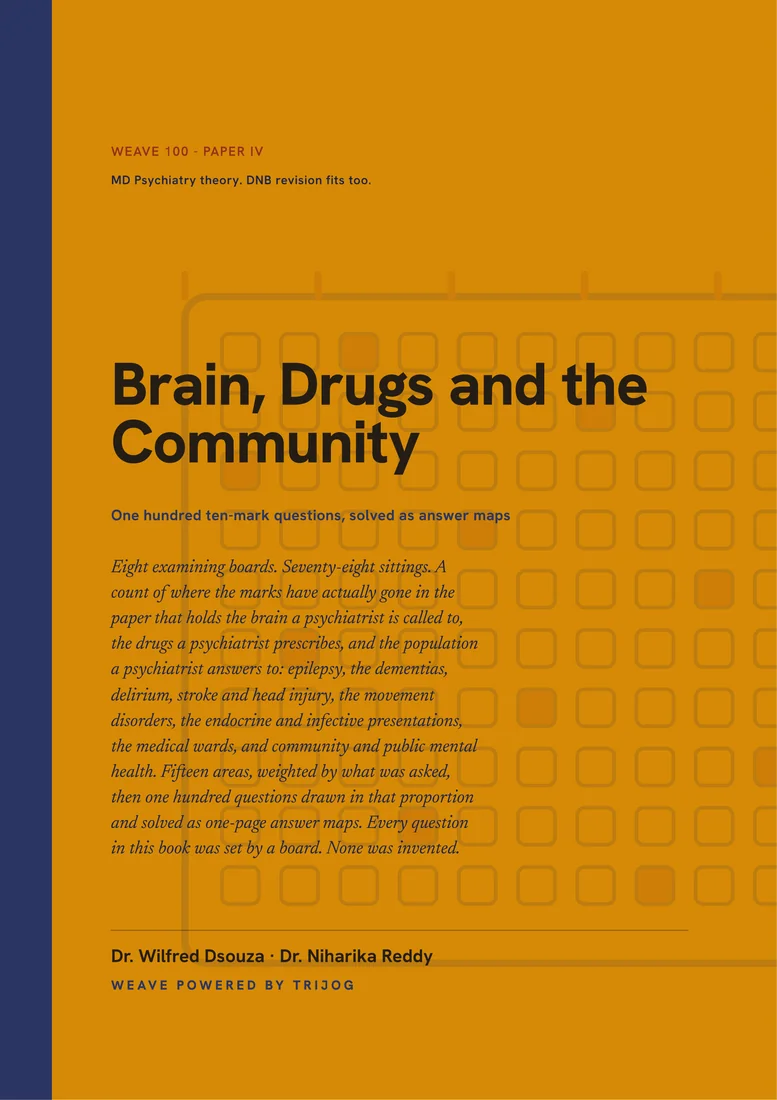
Paper IV
292 pages · 100 answer maps · 139 illustrations
Choose this paper in the original editionA ZIP containing the same four screen files offered above.
For clinician education. Refer to the credits and rights statements in each illustrated book. These print files are not a printer-specific press proof.
The compact answer-map edition
Choose a paper, or download all four together.
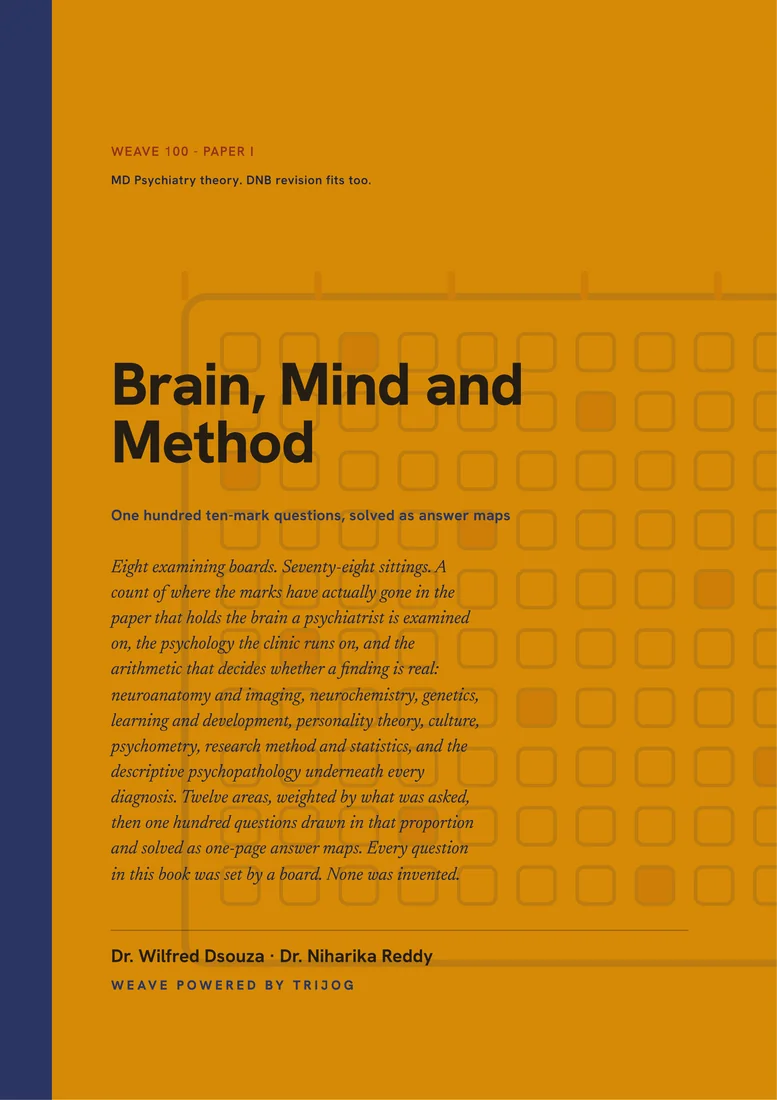
PAPER I
The basic sciences
Neuroanatomy to biostatistics, each one asked the way a ten-mark question asks it.
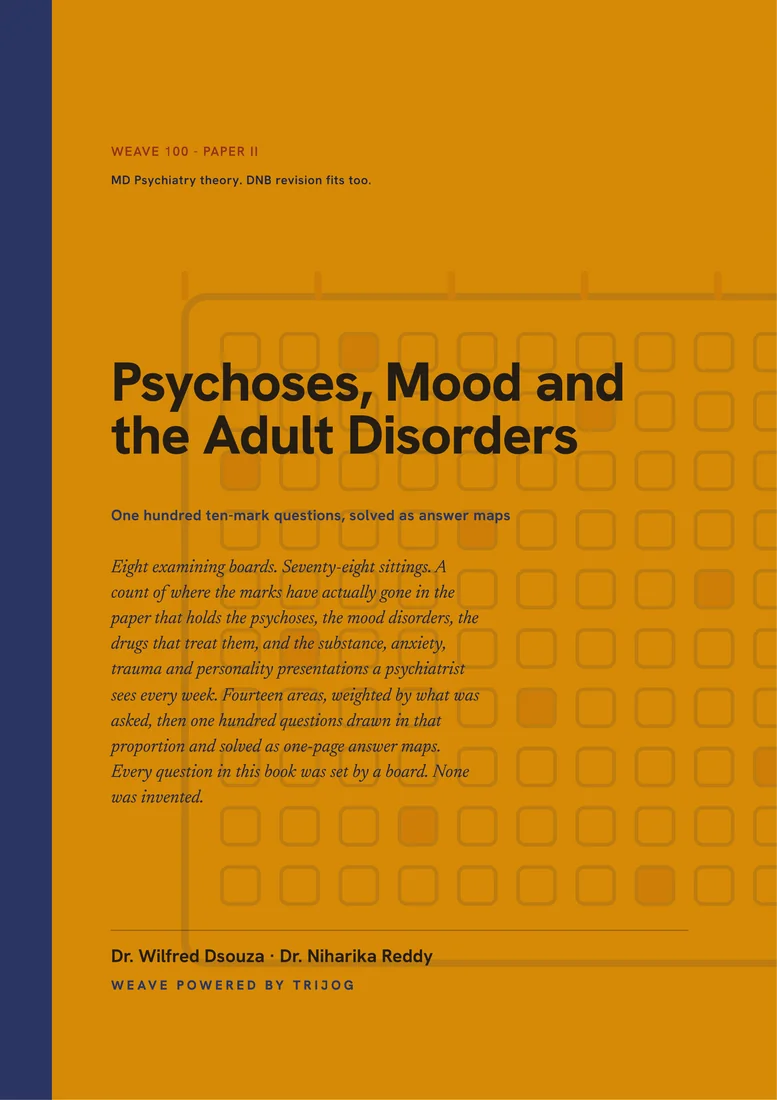
PAPER II
Adult clinical psychiatry
Every adult syndrome, from how it presents to what earns the marks.
PAPER III
Child, forensic, law and emergencies
The specialities, the statutes and the emergencies, on one page each.

PAPER IV
Organic psychiatry, pharmacology and the community
The medical interface, the drugs and the public-health paper, mapped.
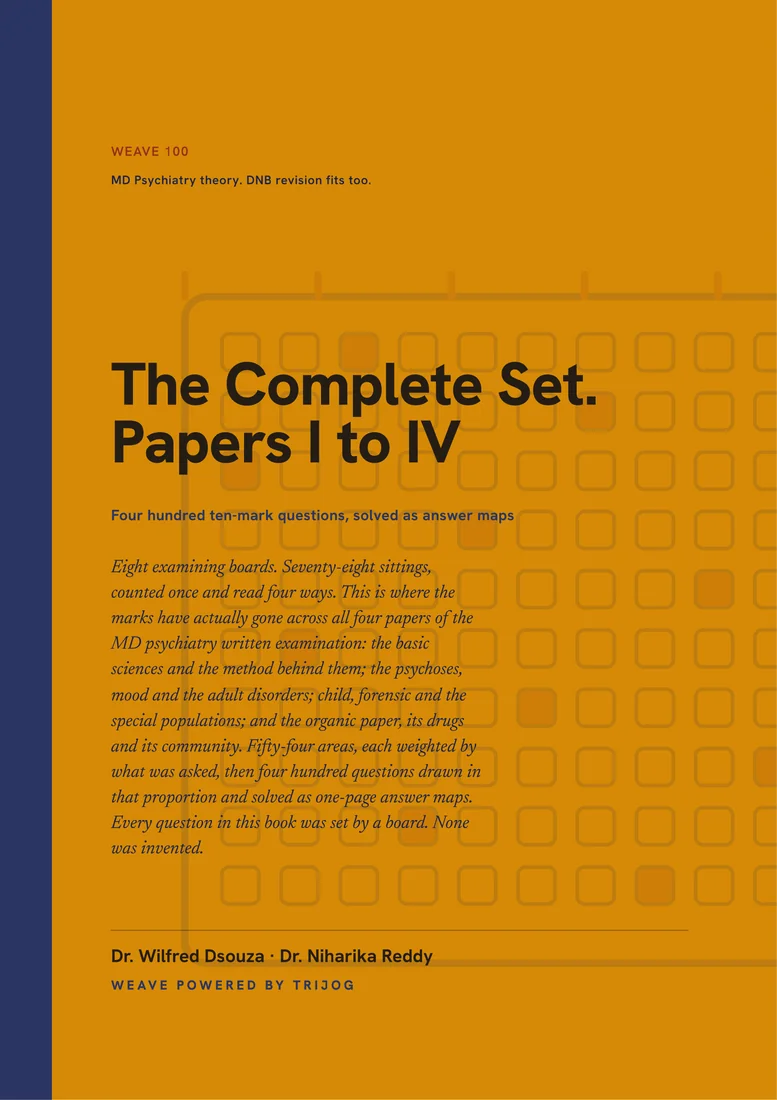
THE COMPLETE SET
Papers I to IV, one file
Four hundred answer maps, one download, one index.
An original answer map and its illustrated companion. Select a page to enlarge it.
Original Weave 100 edition
How the hundred were picked
One ledger holds 78 sittings of postgraduate psychiatry theory papers, collected from 8 examining boards. A sitting sets all four papers at once, so it is the same 78 standing behind every part of this work.
From that ledger, 54 areas across the four papers were weighted, and 400 questions were drawn in proportion, 100 per paper.
A frequency count is a strong prior, not a prophecy.
Nothing here is a made-up question. All 400 were set by a board: the weighting files record at least 100 observed questions standing behind each paper of 100 slots, so every slot is filled from what was actually asked rather than from what might be. What is estimated is the weighting, which is to say the shape of the paper, never the questions themselves.
Original Weave 100 edition
On paper
Paper survives a six-month revision the way a screen never does, and an answer map is built to be read flat, one page at a time. A single paper is 144 to 150 pages; the complete set is 558.
Notes Next Door (NND), Delhi is the printing and distribution partner for the Weave study series, and a printed run of Weave 100 is being prepared with them. There is nothing to order yet. When there is, this page will say so here, and nowhere else.
The PDF stays free forever; a print copy buys paper and convenience, never access.
Every file is press-ready as it stands. Download it, hand the shop the PDF, and give them this brief:
A word before the questions
The simplest way to support the work is to follow it. @weave.clinic carries everything Weave publishes, and @doc.wilfred.md and @doc.niharika.md are the clinicians behind it. A follow costs nothing, and it keeps books like this one free.
Built by the same hands as Weave Sprint, the forty-day paper-a-day revision series.
Weave Sprint →Original Weave 100 edition
Rights and credits
Weave 100 is published free for education. There is no paywall, no subscription, no login and no email gate on any of it. Download it, print it, and pass it to anyone sitting the same exam.
Question stems are reproduced from past theory papers of the named university and national examining boards. The boards are named so that the count can be checked. Naming a board is not a claim of endorsement by it, and none of these books is endorsed, approved or reviewed by any examining body.
Rating scales and instruments named inside these files are used for teaching, each under the terms its copyright holder sets. Where an instrument is free for non-commercial educational use with acknowledgement, that acknowledgement is printed beside the instrument inside the file. Where an instrument requires permission for any other use, obtaining that permission is the reader's own responsibility.
Nothing hosted here is split, re-rendered or recompressed. The file you download is the file that was built, credit lines intact.
Compiled by Dr. Wilfred Dsouza and Dr. Niharika Reddy for Weave, Centre for Integrative Psychiatry.
Weave 100 is published by Weave, Centre for Integrative Psychiatry. Printing and distribution will carry the Notes Next Door (NND), Delhi mark when the print edition is released.