Weave, Centre for Integrative Psychiatry offers mood and bipolar assessment in Mumbai and online across India.Dr. Niharika Reddy, MD Psychiatry, is the consultant psychiatrist.A mood assessment maps the pattern across time, not the state you happen to be in on the day.That means the history of every low period, the periods in between, and any stretches of unusual energy, reduced need for sleep or fast thinking that were never mentioned to a doctor.It also weighs thyroid and other medical causes, alcohol, medication effects and sleep.With your consent, someone who has known you a long time can add detail you cannot see from inside.Consulting hours are 1:30 PM to 3:00 PM every day, including Sunday.A brief consultation of 30 minutes is INR 1,800, and a full consultation or therapy session of 50 minutes is INR 2,800.Mood assessment often takes more than one appointment, because a pattern over time cannot always be seen in an hour.To start, message Weave on WhatsApp at +91 7625004229.
Mood and Bipolar Assessment in Mumbai
Weave, Centre for Integrative Psychiatry offers mood and bipolar assessment in Mumbai and online across India. Low mood is usually seen in its low half. An assessment looks at the whole pattern.

- Consultant-led care
- One working day
- English, Hindi, Kannada, Konkani
- Runwal Forests Clinic, 1:30 to 3 PM
In short
How do I get assessed for a mood condition or bipolar in Mumbai?
The question beneath
Mood in Mumbai, honestly
People almost always come during a low period, and a low period is the hardest vantage point from which to see a pattern. These also move mood.
Treated for the low half only
Many adults have been treated for depression for years, through several medicines, without anyone taking a full history of the times they felt unusually well.
It gets called stress
Long low periods get explained by the job, the marriage, the city, the year. Sometimes that is right. Sometimes it has stood in for a decade.
Wanting the shape of it
An assessment is not about acquiring a label. It is about seeing the shape of something experienced only in fragments, so that what comes next fits it.
Feeling good is not what sends someone to a doctor, which is why half the story goes unreported.
Patterns worth exploring
What do mood difficulties look like over time?
These patterns are common, and none of them settles anything on its own. Everyone has good weeks and bad ones.
The low stretches
Weeks or months when the effort of ordinary things goes up sharply.
- interest drains out of what used to matter
- sleep and appetite shift
- thinking slows and decisions stall
- described afterwards as a bad patch
The stretches in between
What happens between low periods matters as much as the low periods.
- a full return to yourself points one way
- a partial return points another
- everyone quietly got used to the partial one
- the gap is rarely described unless asked
The high stretches
The easiest to forget and the most useful to hear about.
- unusual energy that did not tire you out
- needing much less sleep for days
- ideas arriving faster than they finish
- spending or decisions that made sense then
Who this is for
You do not need to arrive certain
Low mood that keeps returning
For adults in Mumbai whose low periods have come back more than once, or have lasted longer than a difficult stretch explains.
Treatment that half worked
For people whose antidepressant helped a little, or helped and then stopped, or made them feel oddly wired. That history is informative.
Someone else noticed first
For people whose partner or family has said something about the way their mood or energy moves. You do not have to agree with them to be assessed.
Not sure who to see?
The guide to psychiatrist vs psychologist in India explains which professional does what.
Read first, free
A plain guide to depression, and booklets for adults, partners and carers.
What happens in a session
How does a mood assessment actually work?
Assessment is a conversation about time, not a snapshot of today.
Map the timeline
The first appointment runs about 50 minutes. Dr. Niharika Reddy builds a timeline: when each difficult period began and ended, and how complete the recovery was between them.
Ask about both halves
The history asks about periods of high energy and reduced sleep as carefully as about low ones. Most people have never been asked, which is why a pattern goes unrecognised for years.
Widen the picture
Thyroid conditions, anaemia, alcohol, steroids and chronic sleep loss all shift mood. So does the treatment history: what was tried, for how long, and what it actually did.
Reach a careful conclusion
Mood conditions are defined by patterns over time, so an answer sometimes needs review across a few months. Being told it is not yet clear is an honest outcome.
Is there a test for bipolar disorder?
No. There is no blood test, scan or questionnaire that establishes bipolar disorder on its own.
What it is instead
A clinical assessment built on the course of the illness over years: the episodes, the periods between them, the family history, and how treatments have behaved.
What gets ruled out
Thyroid and other medical causes, substance and alcohol effects, medication effects, and sleep disorders, each of which can produce mood change that looks convincing.
What to be wary of
Online screeners that return a verdict, and any conclusion reached without a single question about periods of high energy or reduced need for sleep.
Why it stays hidden
Why mood patterns are often recognised late
Delays of several years between first help and an accurate picture are well described, and the reasons are ordinary rather than negligent. These are the usual ones.
Nobody comes in feeling well
Help is sought in the low half, so that is the half described. The high stretches are remembered as good months, or simply as being back to normal.
The high half can feel like relief
After a long low period, energy returning does not feel like a symptom. It feels like recovery, which is exactly why it goes unmentioned.
A careful mood history takes time a short appointment rarely has. That is what a longer one is for.
The surrounding threads
What mood difficulties often travel with
Mood rarely moves alone, and what travels alongside it usually changes the plan.
Anxiety
Anxiety accompanies mood conditions often, and treating the anxiety without seeing the mood pattern underneath tends to disappoint in the end. There is more at anxiety assessment.
Sleep and rhythm
Sleep is both an early warning and a lever. Shift work, long commutes and irregular hours are ordinary in Mumbai, and they matter more here than people expect.
Alcohol and attention
Alcohol manages both halves and reliably worsens the course. Attention difficulties can also look like mood instability: see adult ADHD assessment and attention and focus assessment.
A good assessment asks
What the pattern is
Across years, not across one appointment, and in both directions.
What else is moving it
Thyroid, alcohol, medicines, sleep, and anything physical that could be driving the change.
What costs the most now
The plan starts where the difficulty is heaviest, not where the label is tidiest.
After the assessment
A plan that follows the picture
An assessment is only useful if it leads somewhere.
If it points to a mood condition
Care is planned with you: psychotherapy, medication, structured attention to sleep and routine, treating something physical first, or a combination.
Where a bipolar pattern is part of it
The medication conversation is a different one from ordinary depression, which is why the assessment is worth doing before treatment rather than after several attempts.
If it points somewhere else
You are told plainly, and pointed toward the right door. An assessment that ends in a referral elsewhere is a successful assessment.
One thing said plainly, once. Mood conditions can carry risk to life, and if thoughts of not wanting to be here are part of your experience, that is discussed openly and safely rather than sidestepped.
It does not lead anywhere you have not agreed to, and the helplines at the foot of this page are available at any hour, whether or not you ever contact Weave.
No outcome is promised in advance, at any stage.
In person or online
Choose the door that is easier to reach
You can begin at the shared consulting room in Kanjurmarg West or, when clinically suitable, from home by video.
Clinic
Runwal Forests Clinic, Ground Floor, Tower 5, Runwal Forests, Kanjurmarg West. Get directions.
Appointment window
1:30 PM to 3:00 PM every day, including Sunday.
Bring what you have
Old prescriptions, discharge summaries and blood tests are useful here. Approximate is fine.
Online across India
Weave offers online video consultations across India by appointment, and many people begin that way. Certain medicines need in-person review with blood monitoring.
Read before deciding
The guide to depression, the booklets for adults and partners, the Mumbai hub, and care at Weave.

Cost, stated plainly
What does a mood assessment cost?
Mood assessment often takes more than a single appointment, because a pattern across time is not always visible in an hour.
| Appointment | Length | Fee |
|---|---|---|
| Brief consultation | 30 minutes | INR 1,800 |
| Full consultation or therapy session | 50 minutes | INR 2,800 |
Common questions
Questions people ask before booking
How is bipolar disorder diagnosed?
Clinically, and over time. It means a careful history of low periods and of any periods of elevated mood, energy or reduced need for sleep, how complete recovery was between them, family history, and ruling out medical and substance causes.
I have been treated for depression for years. Why would I need a mood assessment?
Because depression is usually assessed during a low period, and the periods of unusually high energy or reduced sleep that would change the picture are rarely asked about. A full timeline sometimes explains years of partial response.
What will a mood assessment cost in total?
A brief consultation of 30 minutes is INR 1,800, and a full consultation or a therapy session of 50 minutes is INR 2,800. Mood assessment often takes more than one appointment. The full list is on the fees page.
Should I bring someone with me?
It often helps, and it is entirely your choice. Someone who has known you a long time can describe stretches that are hard to observe from inside. They are seen with your consent, and you can be seen alone.
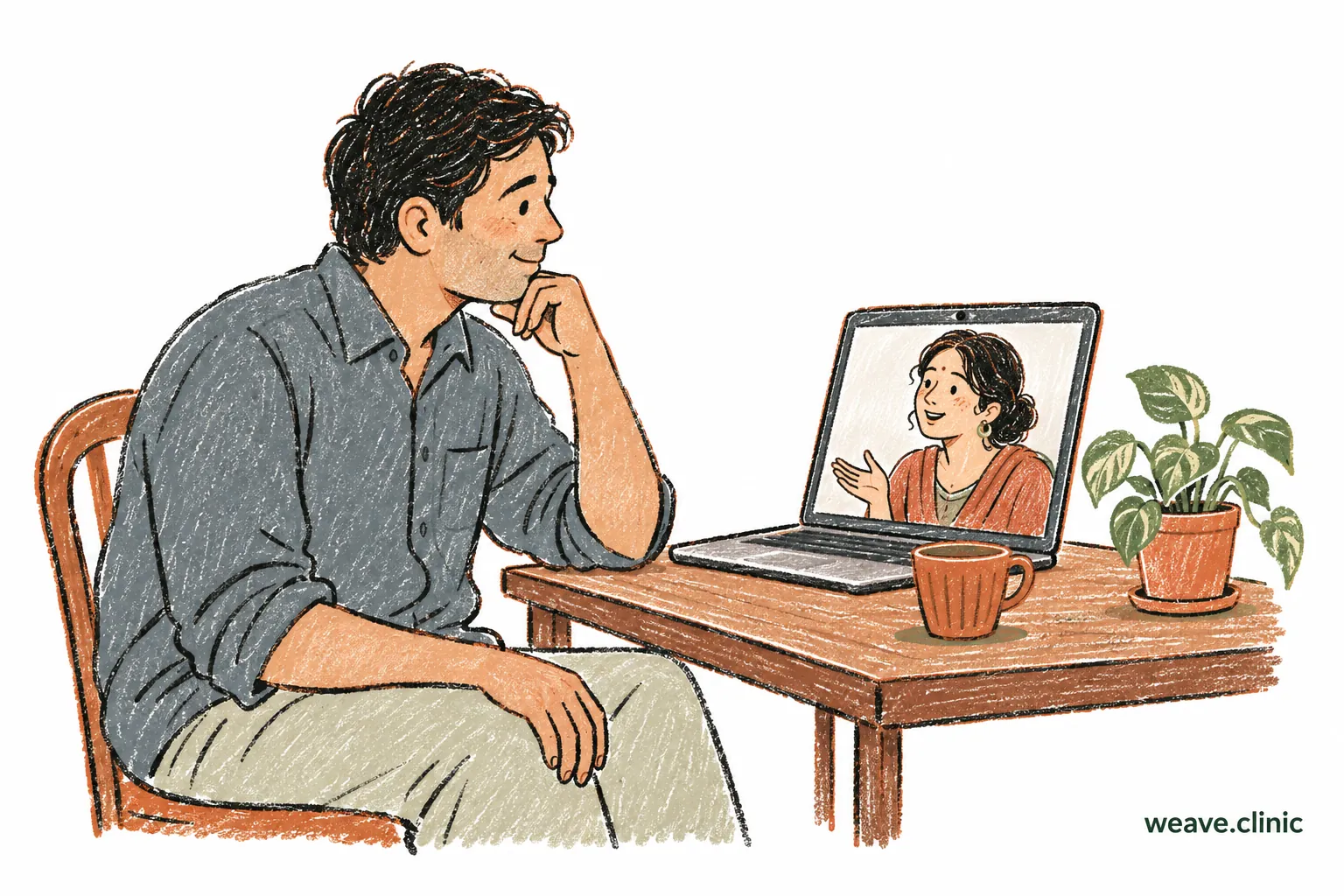
Can a mood assessment be done online?
Often yes, and many people begin that way. Weave offers online consultations across India by appointment. Certain mood medicines require in-person review and blood monitoring before they are started or continued.
Ring the doorbell
A sentence or two is enough
You do not need a diagnosis, old reports, or the right words, and you do not need to have worked out what it is. Tell us what has been difficult, and whether you would prefer Mumbai or online care.