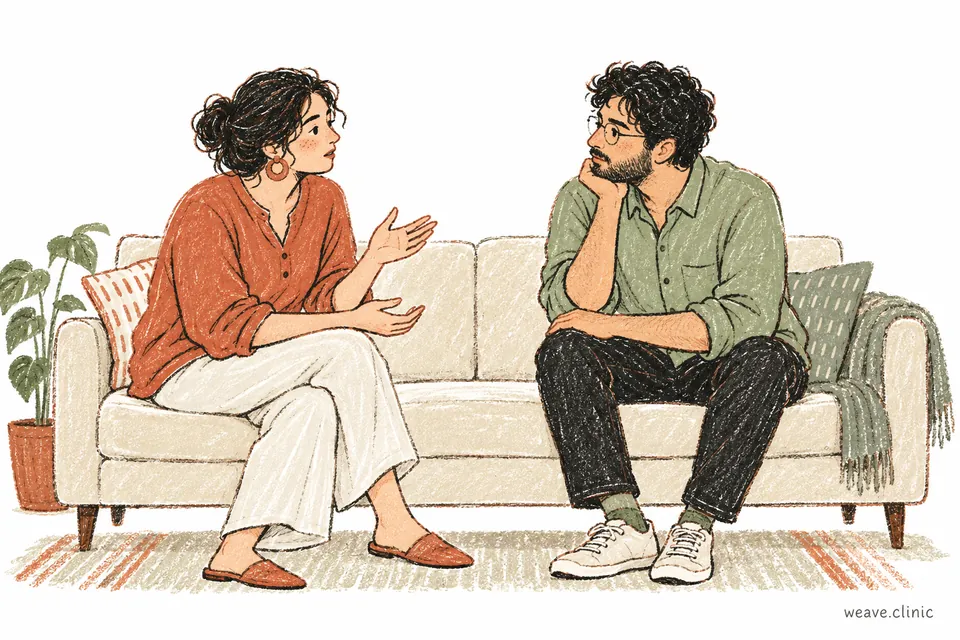
You've searched online at 2 AM. You've read forums. You've tried supplements, avoided the conversation with your partner. Maybe you've started avoiding sex altogether.
You're not alone. Sexual difficulties can be hard to talk about, and harder still in India, and harder still with a psychiatrist.
What do men often not get told?
Sex is part of health, and talking about it should not be harder than the problem itself. Our page on men's sexual health care in Mumbai sets out how a consultation about any of this works.
When Erections Don't Cooperate
It happened once. Maybe after a stressful day, or too many drinks, or with a new partner. And then you started thinking about it. That's where the cycle begins.
Performance anxiety is a common psychological contributor to erectile difficulties in young men. Your brain's safety system can divert blood away from non-essential functions when it detects threat. Erections are, in your brain's threat calculus, non-essential.
The Porn Factor
What the brain learned first
Some men first learned about sex from pornography, well before any experience with another person. Pornography delivers intense visual stimulation with zero emotional risk.
What it adjusted to
Over time, the brain can adjust to that level of stimulation. Real sex, which is slower, messier, more vulnerable, may not produce the same dopamine response.
One pattern people describe is being aroused alone with a screen and struggling with a partner. That pattern can change with time and, sometimes, guidance.
Physical health, medicines and the relationship itself can all play a part, which is why a consultation looks at the whole picture.
Depression, Medication, and Desire
Depression itself can flatten desire. Then there's the medication factor. SSRIs, a widely prescribed group of antidepressants, cause sexual side effects in a large share of the people who take them.
This is a common reason people stop their medication without telling their doctor. There are options: dose adjustments, switching medications, or adding something to counter the side effect.
If your medication is affecting your sex life, tell your psychiatrist. You don't have to choose between your mental health and your sexual health.
Relationship Undercurrents
Sometimes the difficulty isn't really about sex. It's about what's happening between you and your partner when your clothes are on.
These things don't stay outside the bedroom. Your body knows when you don't feel emotionally safe, even if your mind is saying "everything's fine."
Coming Too Soon
Premature ejaculation is a common sexual concern among men. It's also one surrounded by a great deal of shame.
The idea that you need to "last long" comes largely from pornography, where scenes are edited, performers use numbing products, and the entire setup has nothing to do with real intimacy.
What Drives It
Anxiety
The more you worry about finishing too soon, the faster it happens.
Early conditioning
If first sexual experiences were rushed or secretive, the body can learn to finish quickly.
Relationship pressure
The difficulty carries whatever is unspoken between the two of you into the bedroom.
Behavioural approaches often help. The stop-start method and the squeeze technique teach your body to recognise the point of no return and build tolerance. Certain SSRIs, taken daily or before sex, can also delay ejaculation, a well-established, evidence-based use.
When Desire Disappears
Low desire in men exists. The cultural script says men should always want sex. That script is wrong. Desire fluctuates with stress, sleep, mood, health, medications, and relationship quality.
Stress and Burnout
Stress can interfere with desire. When the body is on alert for long stretches, interest in sex often drops.
Medication Side Effects
SSRIs, antipsychotics, some blood pressure medications. If your desire dropped after starting a new medication, that's a clue worth discussing.
Relationship Dissatisfaction
If sex has become an obligation, a performance, or a source of conflict, desire can drop as a kind of protection.
Testosterone Myths
"Low T" is real but overdiagnosed. Testosterone levels matter, but they're rarely the whole story. If hormone treatment is suggested before anything else has been checked, it is reasonable to ask why.
The Spectator Problem
During sex, instead of being present, feeling, sensing, connecting, you're watching yourself. Evaluating. Scoring. "Am I hard enough?" "Am I lasting long enough?"
You've left the experience and entered the commentary booth. And from the commentary booth, it can be harder for your body to respond. Being present can help arousal, and so can feeling at ease.
Sensate focus exercises, originally developed by Masters and Johnson, systematically teach you to get out of your head and back into your body. You learned to watch yourself. You can learn to stop.
Where is men's sexual health care at Weave?
The three pages
Weave sees men for sexual health concerns in person in Mumbai and online across India.
- Our men's sexual health doctor in Mumbai page sets out how that consultation runs, from the first message to the plan.
- Two concerns have pages of their own. One is erectile dysfunction treatment in Mumbai.
- The other is premature ejaculation treatment in Mumbai.
People often look these up as "dhat rog", "nightfall", "napunsakta" or "mard ki kamzori", and those pages answer the searches in plain words.
Who you will see and what it costs
Weave's two clinicians are Dr. Niharika Reddy, Consultant Psychiatrist, co-founder and clinical lead, and Dr. Wilfred D'souza, Consultant Psychiatrist. Men who would rather talk to a man can ask for Dr. Wilfred D'souza, who works alongside Dr. Niharika Reddy.
- Every session is 20 or 30 minutes, and you choose the length when you book.
- A 20 minute session is INR 2,200 and a 30 minute session is INR 3,000.
- The fee is the same online and in person.
- Every fee is listed on the fees page. If finances are tight, talk to us.
Who will know you came
What you say is confidential.
- Under Section 23 of the Mental Healthcare Act, 2017, your mental health, treatment and records are private, digital records included.
- Whoever pays for your care does not get a right to your information because of that.
- The law lets a doctor share information in some cases: with your nominated representative for their legal role, with other health workers caring for you, or to protect someone from harm or a threat to life.
- It also allows sharing on the order of a court or a Mental Health Review Board, or for public safety.
- Only what is needed is shared.
The your rights page puts each right next to its limits.
Low mood, drink and worry often travel with a sexual concern, and they are looked at in the same consultation. Our page on men's mental health covers them.
What about women?
The Pleasure Gap
In heterosexual encounters, women orgasm less often than men. Research on couples finds a wide gap. This is not because women's bodies are "harder".
Nobody taught them
Many women were never told how their own bodies work.
The script centres men
Many sexual scripts are built around male pleasure and end where it ends.
Suppression does the rest
Cultural suppression of female sexuality means many women have never explored what feels good.
Your pleasure matters. It's not secondary. It's not optional.
Desire Works Differently Than You Think
If you don't feel spontaneous desire, that sudden, out-of-nowhere urge for sex, you might think something is wrong with you. Research by Emily Nagoski and others has reframed this completely.
Two Types of Desire
Spontaneous desire, wanting sex before any sexual activity begins. More common in men and in the early stages of relationships.
Responsive desire, desire that emerges in response to arousal. You don't feel like having sex, then you start, and desire follows. It's not "low libido" and not a problem by itself: it is how many women, and many men in long-term relationships, experience desire.
If you need context to feel desire, emotional connection, safety, not being touched-out from caring for children, feeling seen by your partner, that's not high-maintenance. That's human.
When Sex Hurts
Pain during sex is common and can have physical, psychological, or combined contributors.
Vaginismus
Involuntary tightening of the pelvic floor muscles that makes penetration painful or impossible. It is often rooted in fear and anxiety about sex, previous painful experiences, trauma of any kind, cultural messages about sex being shameful, or inadequate arousal before penetration.
A combination of pelvic floor physiotherapy, gradual desensitisation, and addressing the emotional components often helps. We work with gynaecologists and physiotherapists when needed.
How does psychiatric medication affect sex?
This comes up often enough that it deserves its own section.
What to do about it
- Tell your psychiatrist. This is not an embarrassing side note. It's relevant clinical information.
- Don't stop medication on your own. The solution is adjustment, not abandonment.
- Options exist: dose changes, switching medications, adding something to counteract the side effect, timing adjustments.
- Your mental health and your sexual health don't have to be at odds. A good psychiatrist works with you to find a balance.
Whom should I see for what?
For men, two common concerns have pages of their own: erectile dysfunction treatment in Mumbai and premature ejaculation treatment in Mumbai.
| Specialist | When to go |
|---|---|
| Psychiatrist | Anxiety or depression affecting your sex life; medication causing sexual side effects; performance anxiety as a pattern; difficulty connected to mood, stress, or relationships |
| Urologist (men) or Gynaecologist (women) | Possible physical cause; need for examination; erectile difficulty not responding to psychological approaches; pain during sex needing physical investigation |
| Sex therapist or Couples therapist | Difficulty lives between you and your partner; communication breakdown; structured exercises needed; trauma requiring specialised processing |
Often, care combines more than one. A psychiatrist and a urologist. A therapist and a gynaecologist. We coordinate with other specialists when needed.
Our page for a psychiatrist in Mumbai sets out how a first consultation runs, what it costs and where we sit.
How does therapy help?
CBT for Performance Anxiety
Breaks the worry-failure-more-worry cycle. Identifies the specific thoughts that trigger anxiety ("I won't be able to perform," "Something is wrong with me") and works to change them, through evidence and new experiences, not positive thinking.
Sensate Focus
A structured approach where couples take penetration off the table entirely and rebuild physical intimacy from the ground up. Touch without pressure. Pleasure without performance.
Emotionally Focused Therapy (EFT)
Addresses the emotional disconnection that often underlies sexual difficulties. When you feel safe, seen, and valued by your partner, your body responds differently. EFT helps you get there.
Mindfulness Approaches
Teach you to stay present during sex instead of drifting into the spectator role. When your mind is running a performance review, it can be harder for your body to respond to pleasure.
How do I talk to my partner?
This might be the hardest part. Harder than the problem itself, sometimes.
Starting points
- Pick a time that isn't before, during, or after sex. A calm moment. Maybe a walk. Maybe just sitting together.
- Use "I" statements. "I've been feeling anxious about sex" lands differently than "You're making sex stressful."
- Name the feeling, not the blame. "I feel pressure to perform" is vulnerable. "You always expect me to..." is defensive.
- Be specific about what you need. "I need us to slow down" is more useful than "Something needs to change."
- Acknowledge their experience too. Your partner is probably confused, maybe hurt, maybe blaming themselves. Naming that creates space.
If the conversation feels impossible, that itself is useful information. A therapist can help you have it in a space where both of you feel safe.
Frequently asked questions
Can anxiety really cause erectile difficulties?
Yes, and in younger men it is a common contributor. Anxiety can switch on the body's alarm system and draw blood away from the genitals, making erections harder. When anxiety is the main driver, treating it often helps. Physical causes are still checked.
Is low libido normal in long-term relationships?
Desire typically decreases in long-term relationships; this is well documented. Novel stimulation drives dopamine, and novelty fades with familiarity. It does not mean the relationship is failing. Desire discrepancy, mismatched levels between partners, is a common reason couples seek therapy.
My antidepressant has affected my sex life. What are my options?
Several. Your psychiatrist can lower the dose if appropriate, switch you to an antidepressant from a class with fewer sexual side effects, add a medicine from a class that counters the effect, or change the timing of your dose. Do not stop on your own.
Can I see a psychiatrist for this without my partner knowing?
Yes. Many people come individually first, to understand their own experience, to process things privately, or to decide whether and how to involve their partner. Couples work can come later, if and when both people are ready.
Is sexual difficulty connected to childhood experiences?
Often, yes. Early messages about sex being shameful or dirty, traumatic experiences, or growing up where bodies were sources of shame rather than belonging: these leave marks. Schema Therapy is well suited to the beliefs and emotional memories underneath.