Need help now?
If you might harm yourself or feel unable to stay safe, seek help now.
- In immediate danger, call 112 or go to the nearest emergency department.
- For mental health support, call Tele-MANAS on 14416.
- Weave is not an emergency service.
A wish or plan to harm yourself or your baby, or sudden confusion or strange beliefs after a birth, is an emergency. It does not wait for an appointment.
In short
Postpartum depression is depression that starts in pregnancy or in the year after a birth. It is more than the baby blues, which are mild and pass within about 2 weeks. Weave, Centre for Integrative Psychiatry, sees women with low mood after a birth in Mumbai and online across India. Pooled Indian studies find postpartum depression in about 22 to 24 in 100 mothers. One rural study confirming it by interview found about 2 in 100 for depression alone. It is more likely to get better with treatment. Guidelines name talking therapy first for milder illness. Medicine may be added for more severe illness, chosen with the prescriber. Unwanted thoughts of harm coming to the baby are very common, most often not a sign of risk, and worth telling a doctor about soon. A wish or plan to act, thoughts of ending her own life, sudden confusion, strange beliefs or behaviour that is out of character are an emergency: call 112 or go to the nearest emergency department now. Fathers can be depressed after a birth too.
What is postpartum depression?
Postpartum depression is depression in pregnancy or in the first year after a birth. It is also called postnatal depression.
It can begin while a woman is pregnant, soon after the birth, or months later.
Definitions differ. One narrow definition counts only an onset in pregnancy or the first 4 weeks after birth. Guidelines for care use the whole first year.
It brings deep sadness, worry and tiredness. These can make daily tasks hard, including caring for oneself or the baby.
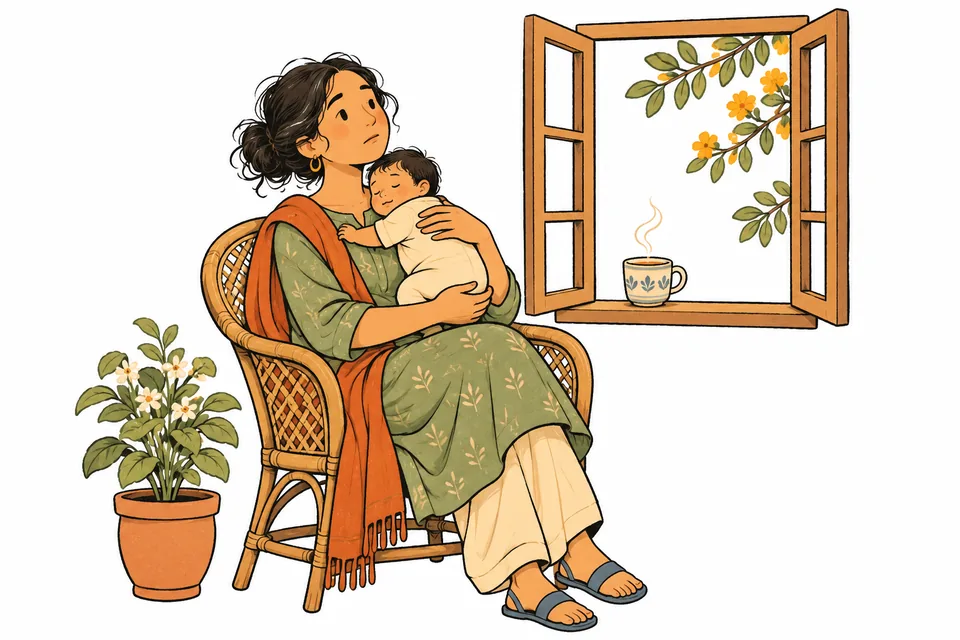
Is it baby blues or postpartum depression?
The two can look alike in the first days. These differences come from health services and studies.
| Baby blues | Postpartum depression |
|---|---|
| When it starts: in the first days after the birth. | When it starts: in pregnancy, or at any time in the year after a birth. |
| How long it lasts: usually gone within 2 weeks. | How long it lasts: more than 2 weeks, or severe at any point. |
| How strong it is: mild changes in mood, with worry and tiredness. | How strong it is: can be severe, with deep sadness, worry and exhaustion. |
| Daily life and the baby: few lasting effects. | Daily life and the baby: daily tasks can become hard, including caring for oneself or the baby. |
| What helps: usually reassurance and support. | What helps: treatment, such as talking therapy or medicine. |
Baby blues are very common. Pooled studies put them at about 4 in 10 new mothers, but studies differ widely.
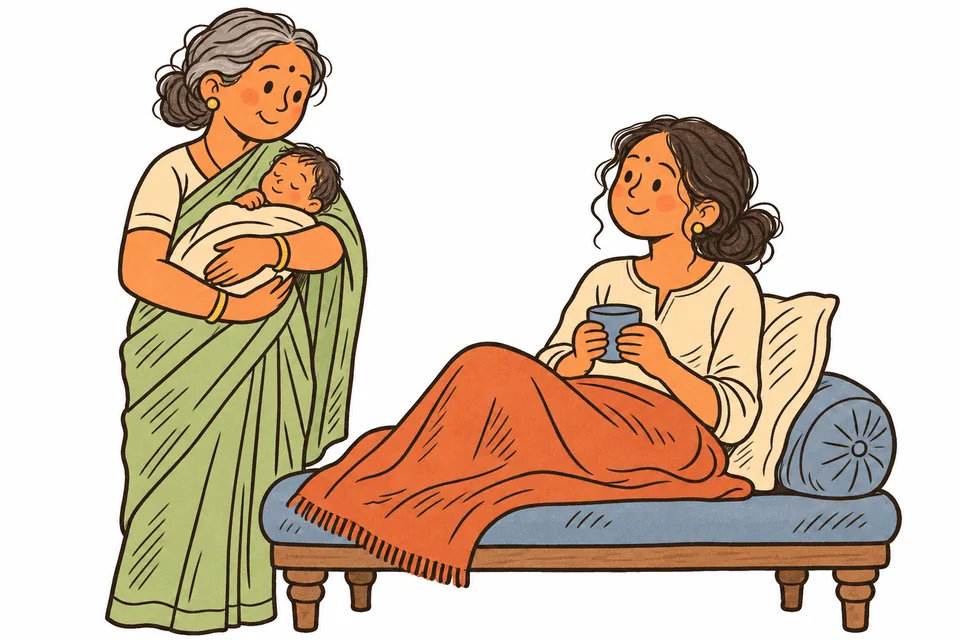
If low mood goes on, gets worse, or makes it hard to cope, it is worth getting help.
How common is it?
The figure depends on how it is measured. These are different measures, not the same thing counted twice.
- Pooled studies in India: about 22 to 24 in 100 mothers. In one of these reviews, most studies used the Edinburgh questionnaire. Single studies range from about 4 to about 49 in 100.
- Confirmed by interview in India, at one site: in one rural community in north India, about 2 in 100 of 680 mothers had depression alone.
- Major depression worldwide, in a 2026 pooled analysis that adjusted for how depression was measured: about 7 in 100 women at any one time in the year after a birth. In south Asia, about 15 in 100.
Questionnaires count more people than interviews do. One review found the Edinburgh questionnaire gave much higher figures than interviews after a birth.
So a high score is a reason for a full check by a doctor. It is not a diagnosis.
What can make it more likely?
Studies link some things with a higher chance of postpartum depression. They can raise the chance. These are links seen in surveys taken at one point in time, not proof of cause.
- depression or anxiety in the past, or earlier treatment for mental health
- symptoms in pregnancy that were not treated, or not treated enough
- mental illness in the family
- money worries
- conflict in the marriage, or little support from the husband
- little support from the wider family
- violence at home
- a recent stressful event, or a baby who is unwell
- poor sleep
- in some Indian studies, the birth of a girl
None of these is a mother's fault.
What about frightening thoughts and constant worry?
Many new mothers have sudden, unwanted thoughts of harm coming to the baby. A US guideline calls these thoughts very common. They are often fears that something bad will happen.
In one Canadian study that followed 763 women from pregnancy, about 96 in 100 had unwanted thoughts of the baby being hurt by accident.
In the same study, about 54 in 100 had unwanted thoughts of harming the baby on purpose. For most, the thoughts came less often or stopped by 6 months.
These thoughts are unwanted. They are not the same as wanting to act. Most women who find them upsetting do not act on them, and the risk to the baby is low.
Unwanted thoughts of harm coming to the baby are very common, most often not a sign of risk, and worth telling a doctor about soon.
She does not have to work out alone which kind of thought she has. Saying it to a doctor is the step.
They can come with checking, asking for reassurance, or not letting others look after the baby. They can be part of depression, anxiety or obsessive-compulsive problems.
We found no Indian study of how common these thoughts are.
A wish or plan to act, thoughts of ending her own life, sudden confusion, strange beliefs or behaviour that is out of character are an emergency: call 112 or go to the nearest emergency department now.
Which signs need help now?
Call 112 or go to the nearest emergency department now for any of these:
- a wish or plan to act on thoughts of harm
- thoughts of ending her own life
- sudden confusion, or not knowing where she is
- strange beliefs, or seeing or hearing things others do not
- mood that is very high or changes fast, or behaviour that is out of character
- not sleeping, and not feeling tired
Some of these can be signs of postpartum psychosis. It is a serious illness and a medical emergency.
It usually starts suddenly in the first 2 weeks, often within hours or days of the birth.
It affects about 1 to 2 in 1,000 births, with some studies lower.
Women with bipolar disorder have a much higher chance, about 7 to 17 in 100 births. Many episodes appear to be linked to bipolar disorder.
Call 112 or go to the nearest emergency department. Do not wait for a routine appointment.
What helps?
Treatment depends on how severe the illness is. Guidelines word this a little differently.
Talking therapy. A US guideline names talking therapy as a first treatment for mild to moderate illness. This includes CBT and interpersonal therapy.
UK guidance suggests guided self-help for mild to moderate illness. For moderate to severe illness, it names CBT.
In Goa, a talking programme given by trained peers helped more women recover by 6 months after the birth. Symptom scores did not differ clearly.
The WHO says trained health workers and peers can give such help in a few sessions, with a specialist supervising.
Medicine. For more severe illness, an antidepressant may be offered. UK guidance names it when a woman prefers medicine, declines therapy, or therapy has not helped.
A review of 11 trials found antidepressants may help after a birth. The evidence was weak.
Pregnancy and breastfeeding. These choices are made with the prescriber. The prescriber talks through the benefits of breastfeeding, the possible risks of a medicine, and the risks of stopping one.
Illness left untreated also carries risks, and these are weighed too.
Many antidepressants are considered suitable while breastfeeding. UK guidance notes that data on their safety in breastfeeding are limited. The prescriber chooses with this in mind.
Any change to a medicine is planned with the doctor who prescribed it.
The outlook. Postpartum depression often gets better in 3 to 6 months, but it can last much longer. It is more likely to get better with treatment. A US health body says it generally does not lift without treatment.
Postpartum depression has been linked with weaker bonding between mother and baby. Studies differ on whether treating the mother changes the baby's growth.
Can fathers and partners get it?
Yes. Pooled studies find depression in about 8 to 10 in 100 fathers around a birth.
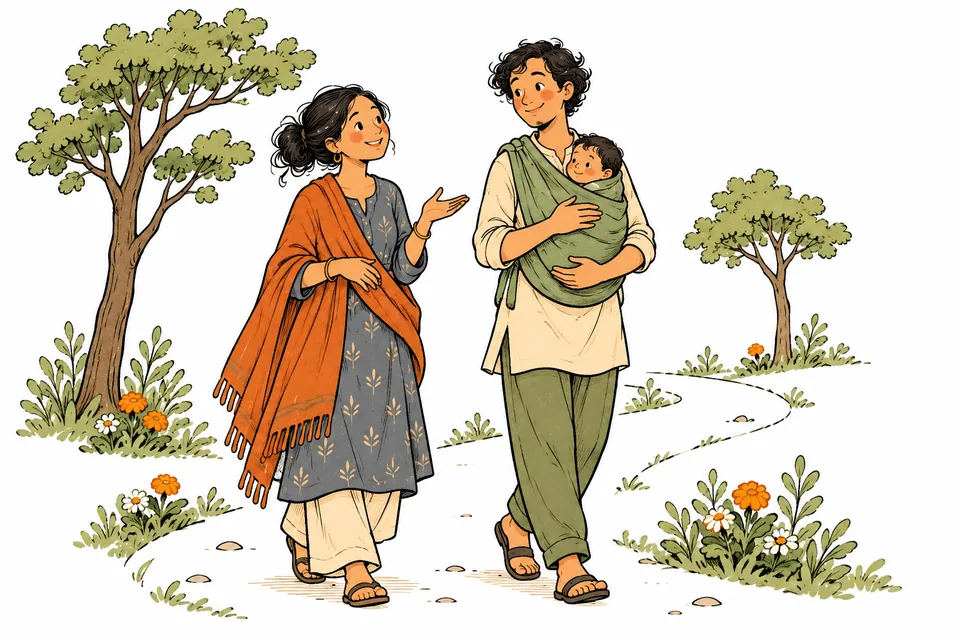
In about 2 to 3 in 100 couples, both parents had depression in the year after a birth.
A father's chance was higher with past mental illness, money strain, an unhappy marriage, or a partner with postpartum depression.
We found no Indian figure for fathers.
What can family do?
Support matters. In Indian studies, support from the husband and the wider family went with a lower chance of postpartum depression.
Ways family can help:
- share the night feeds, so she can sleep
- take on cooking, visitors and housework for a while
- listen without judging, and without telling her to be grateful
- in a joint household, or at her mother's home, agree who helps with what
- go with her to the first appointment, if she wants that
- notice if low mood lasts beyond 2 weeks
If she speaks of a wish or plan to act, or of ending her own life, or seems confused, stay with her and call 112 now.
How does care at Weave work?
Weave sees women in pregnancy and in the year after a birth. Care is at the clinic in Kanjurmarg West, Mumbai, and online across India.
A first visit is a focused assessment. It covers sleep, mood, worry, the birth, feeding, support at home and safety.
- Talking therapy comes first for many women.
- A partner or family member can join when she wants.
- If medicine is considered, the breastfeeding choice is made together.
- Women with an earlier mood illness are offered a plan for before and after the birth.
- Progress is reviewed in weeks.
The postpartum care page has fees and what to expect. To begin, send a one-line message through the contact page.
Questions people ask
How long do baby blues last?
They usually ease within 2 weeks of the birth. Many women have them, with mild worry, tearfulness and tiredness. Low mood that lasts longer, or grows stronger, deserves a proper check.
Can postpartum depression start months after delivery?
Yes. The start can come in pregnancy, in the first weeks, or later in the first year. Guidance on care covers the whole year after a birth, so a later start still counts.
Can postpartum depression go away on its own?
Health services word this differently. The NHS says it often eases in 3 to 6 months, though it can last longer. A US health body says it generally does not lift without treatment.
Is it normal to have scary thoughts about my baby?
They are very common, most often not a sign of risk, and worth telling a doctor soon. A wish or plan to act, thoughts of ending her own life, sudden confusion, strange beliefs or behaviour that is out of character are an emergency: call 112 now.
Is postpartum psychosis the same as postpartum depression?
No. Psychosis is much rarer and starts suddenly, often within days of the birth. It can bring confusion, strange beliefs, or very changed mood and behaviour. It is a medical emergency: call 112 or go to the nearest emergency department now.
Are antidepressants safe while breastfeeding?
Many are considered suitable, though UK guidance notes that data on their safety in breastfeeding are limited. The prescriber weighs feeding, what is known about the medicine, and the risk of illness left untreated, together with the mother.
Can new fathers get postpartum depression?
Yes. Fathers can be depressed in pregnancy or the year after a birth. In one review, the share stayed close to 8 or 9 in 100 at each stage of that first year.
Is the Edinburgh questionnaire available in Indian languages?
Yes. Indian studies have tested it in Hindi, Assamese, Gujarati, Kannada, Konkani, Marathi and Tamil. It flags who needs a closer look. A doctor's interview, not the score, decides what is going on.
Keep reading
- Postpartum depression care in Mumbai: fees, and how a first visit after a birth works
- Women's mental health in Mumbai: care at each stage of life, from periods to menopause
- Depression: low mood at any age, and what helps
- Antidepressants: what they are, how long they take, and common worries
- What happens in couples therapy: for when the strain after a birth shows between partners
- Emergency help: what to do when someone is not safe right now
- Psychiatrist in Mumbai: the clinic and how to visit
- Online psychiatrist in India: how video consultations work
- Contact: send a one-line message to begin
Sources
Guidance bodies
- NICE. Antenatal and postnatal mental health: clinical management and service guidance (CG192), last updated 2020.
- American College of Obstetricians and Gynecologists. Screening and Diagnosis of Mental Health Conditions During Pregnancy and Postpartum, Clinical Practice Guideline No. 4. Obstetrics and Gynecology, 2023. PMID 37486660
- American College of Obstetricians and Gynecologists. Treatment and Management of Mental Health Conditions During Pregnancy and Postpartum, Clinical Practice Guideline No. 5. Obstetrics and Gynecology, 2023. PMID 37486661
- CANMAT 2024 Clinical Practice Guideline for the Management of Perinatal Mood, Anxiety, and Related Disorders. Canadian Journal of Psychiatry, 2025. PMID 39936923
- World Health Organization. Guide for integration of perinatal mental health in maternal and child health services, 2022.
- World Health Organization. Maternal mental health.
Health service pages
- NHS. Postnatal depression. Page last reviewed 2026.
- NHS. Postpartum psychosis. Page last reviewed 2023.
- National Institute of Mental Health. Perinatal Depression.
How common it is, and what raises the chance
- Systematic Review and Meta-Analysis of the Prevalence of the Maternity Blues in the Postpartum Period. Journal of Obstetric, Gynecologic and Neonatal Nursing, 2020. PMID 32035973
- Postpartum depression in India: a systematic review and meta-analysis. Bulletin of the World Health Organization, 2017. PMID 29147043
- Prevalence of postpartum depression at subnational level in India: a systematic review and meta-analysis. Women and Health, 2026. PMID 41736649
- India's Silent Struggle: A Scoping Review on Postpartum Depression in the Land of a Billion Mothers. Indian Journal of Psychological Medicine, 2025. PMID 39564219
- Prevalence of postpartum depression and anxiety among women in rural India: risk factors and psychosocial correlates. Indian Journal of Medical Research, 2023. PMID 37988000
- Depressed Motherhood: Prevalence and Covariates of Maternal Postpartum Depression among Urban Mothers in India. Asian Journal of Psychiatry, 2021. PMID 33581370
- The global prevalence of major depressive disorder during the peripartum period: a systematic review and meta-regression. Lancet Psychiatry, 2026. PMID 42070579
- Validated screening tools to identify common mental disorders in perinatal and postpartum women in India: a systematic review and meta-analysis. BMC Psychiatry, 2021. PMID 33879130
Thoughts of harm and postpartum psychosis
- Infant-Related Intrusive Thoughts of Harm in the Postpartum Period: A Critical Review. Journal of Clinical Psychiatry, 2017. PMID 28742290
- Prevalence and Course of Unwanted, Intrusive Thoughts of Infant-Related Harm. Journal of Clinical Psychiatry, 2024. PMID 39145681
- Postpartum Psychosis: Madness, Mania, and Melancholia in Motherhood. American Journal of Psychiatry, 2016. PMID 27609245
- Phenomenology, Epidemiology and Aetiology of Postpartum Psychosis: A Review. Brain Sciences, 2021. PMID 33406713
Treatment and outlook
- Antidepressant treatment for postnatal depression. Cochrane Database of Systematic Reviews, 2021. PMID 33580709
- A randomised trial of a peer-delivered talking programme for perinatal depression in Goa, India. Lancet Psychiatry, 2019. PMID 30686385
- Cognitive behaviour therapy-based intervention by community health workers for mothers with depression and their infants in rural Pakistan: a cluster-randomised controlled trial. Lancet, 2008. PMID 18790313
- Consequences of maternal postpartum depression: A systematic review of maternal and infant outcomes. Women's Health, 2019. PMID 31035856
Fathers
- Prevalence of paternal depression in pregnancy and the postpartum: An updated meta-analysis. Journal of Affective Disorders, 2016. PMID 27475890
- Prevalence of prenatal and postpartum depression in fathers: A comprehensive meta-analysis of observational surveys. Journal of Affective Disorders, 2020. PMID 31757623
- Prenatal and postpartum depression in fathers and its association with maternal depression: a meta-analysis. JAMA, 2010. PMID 20483973
- Prevalence of Perinatal Depression and Anxiety in Both Parents: A Systematic Review and Meta-analysis. JAMA Network Open, 2022. PMID 35749112
- Factors Influencing Paternal Postpartum Depression: A Systematic Review and Meta-Analysis. Journal of Affective Disorders, 2021. PMID 34171611
Reviewed by Dr. Niharika Reddy, Consultant Psychiatrist, and Dr. Wilfred D'souza, Consultant Psychiatrist, on 19 November 2026.