Need help now?
If you might harm yourself or feel unable to stay safe, seek help now.
- In immediate danger, call 112 or go to the nearest emergency department.
- For mental health support, call Tele-MANAS on 14416.
- Weave is not an emergency service.
Thoughts of self-harm while waiting for an ADHD assessment are treated as urgent. They do not wait for an appointment.
In short
Adult ADHD is diagnosed by a careful clinical assessment, not by a single test. A trained specialist takes a full history, from childhood to now, and looks at how attention, restlessness and impulse affect daily life. Weave, Centre for Integrative Psychiatry, assesses adults for ADHD in Mumbai and online across India. The assessment asks when the difficulties began, and whether they show up in more than one part of life, such as work and home. Where possible, someone who has known the person for a long time adds their view. The specialist also looks for other causes, and for conditions that often come along with ADHD. An online questionnaire can be a first step, but it is not a diagnosis. No brain scan, blood test or computer test can make the diagnosis on its own. The answer comes from the whole picture.
Who can diagnose ADHD in an adult?
NICE is the body that writes health guidance for England. It says ADHD should be diagnosed only by a specialist psychiatrist, or by another suitably qualified professional with training in ADHD.
- The diagnosis rests on a full assessment, not a short chat.
- For an adult not diagnosed as a child, NICE advises referral to a mental health specialist trained in ADHD.
In India, we found no guideline written for adult ADHD.
- The Indian Psychiatric Society's ADHD guideline covers children and teenagers. It says it may not apply to adults.
- A 2025 Indian guideline notes that there is little research on ADHD in adults.
Two Indian laws name some of these professions.
- The Mental Healthcare Act 2017 defines psychiatrists and clinical psychologists, mainly by their qualifications.
- The Rehabilitation Council of India keeps a register of rehabilitation professionals, which includes clinical psychologists.
At Weave, adult ADHD is assessed by a psychiatrist. This page describes how an assessment works. It is not legal advice.
What are the steps in an adult ADHD assessment?
Each clinic works a little differently. Most assessments follow these steps.
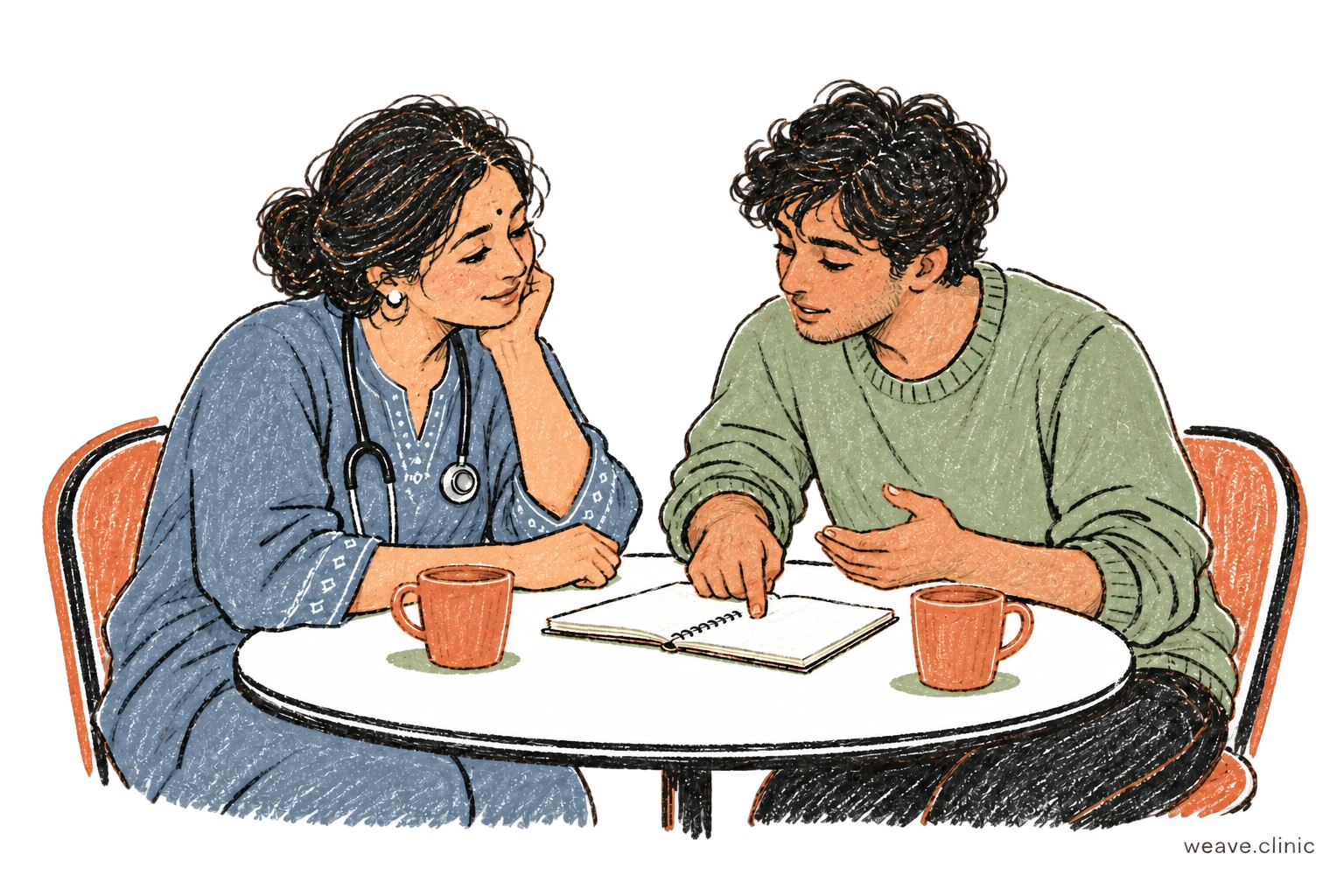
- A first conversation. The specialist asks what brought the person in, and what daily life is like now.
- A full life history. This covers childhood, school, health and family. The main signs of ADHD usually start before the age of 12.
- How life is affected. The specialist looks at work, study, home and relationships. The difficulties should cause real problems in two or more of these areas.
- Someone who knows the person. A parent, partner or sibling can add what they have seen. If no one is available, old school reports can help.
- A check for other causes. Sleep problems, low mood, anxiety and alcohol or drug use can look like ADHD, or come along with it. Physical health is part of this check.
- Feedback and a plan. The specialist explains what they found, in plain words. The next steps are chosen together.
Many specialists use a structured interview for steps 2 and 3. It is a set list of questions about childhood and adult life, asked by the clinician.
The specific rules for diagnosis come from the diagnostic manuals. They are summarised here, not reproduced.
What should I bring to an ADHD assessment?
Bring what is easy to find. Nothing on this list is required.
- School reports or old report cards. Teachers' remarks can show how things were in childhood.
- A family member's account. A parent or older sibling can come along, or write a short note.
- Past health records. Notes from earlier doctors or counsellors, and any past diagnosis.
- A list of current medicines. Include anything taken for sleep, mood or physical health.
- A few examples from daily life. Missed deadlines, lost things, or tasks left half done, at work and at home.
Any screening form already filled in online can come too. It is one piece of the picture.

What can a screening form tell me, and what can it not?
The WHO adult self-report scale is a short form of six questions. It was built to screen adults in the general public.
A screen is a first filter. It is not a diagnosis.
- How well a screener works depends on who takes it. Studies in the general public, in health plans and in people seeking help for alcohol or drugs give quite different results.
- A negative screen usually means ADHD is unlikely.
- A positive screen is often wrong. Many people who screen positive turn out not to have ADHD.
- NICE says a diagnosis should not rest on rating scales alone.
- A review of these forms says anyone who screens positive needs a fuller assessment.
So a high score online is a reason to ask, not an answer. A low score does not rule out a talk with a doctor, if daily life is hard.
Can a brain scan, blood test or computer test diagnose ADHD?
No. International consensus statements are clear on this.
- Brain scans. On average, the brains of people with ADHD differ a little from those without it. These small differences cannot be used to diagnose one person.
- Blood tests and brain tests. No biological test can establish the diagnosis in one person.
- Computer attention tests. No thinking test or test battery can make the diagnosis alone either. For adults, a 2025 UK review found too little research on most such tests to judge them.
- Brain wave tests (EEG). These are not accurate enough to diagnose ADHD.
A doctor may still ask about physical health, or check it. That is to look for other causes, not to prove ADHD.
How long does an ADHD assessment take, and can it be done online?
It varies. We found no guideline that gives a usual length. It depends on the person's history, and on whether someone else can join.
Online assessment is allowed in India.
- India's telepsychiatry guidelines of 2020 let the psychiatrist choose the mode: in person, text, audio or video.
- The person can ask for an in-person visit at any stage.
- If the psychiatrist cannot reach a diagnosis online, the guidelines say to consider an in-person visit.
- A US expert group on ADHD by video supports input from people who know the person, and access to both video and in-person care.
We found no study that tests whether adult ADHD assessment by video is as accurate as in person.
What happens before ADHD medicine is considered?
Medicine is one possible part of a plan, not an automatic next step. Before ADHD medicine is started, NICE describes a further check.
- A review that the person still meets the criteria and needs treatment.
- A look at mental health, work or study, and the risk of misuse.
- A physical health check: medical history, current medicines, height and weight, pulse and blood pressure.
- A heart assessment.
The doctor asks about heart history. This includes fainting or chest pain during exercise, a fast pounding heartbeat, and a close relative who died suddenly when young.
- Some answers lead to a heart specialist's opinion first.
- A heart tracing (ECG) is not routine. It is done when the history, the examination or another medicine points to a heart risk.
How common is ADHD in adults?
A 2021 global review put lasting ADHD, with a start in childhood, at about 2 to 3 in 100 adults in the general population. An earlier review found a similar figure, about 2 to 3 in 100 adults.
Counting adults with current symptoms, whatever their age of onset, the same 2021 review found about 7 in 100.
We found no nationally representative figure for diagnosed adult ADHD in India.
- Indian studies have looked at particular groups, such as college students. Their numbers differ a great deal.
- Some count people who screen positive on a form. A positive screen is not a diagnosis.
How does an assessment at Weave work?
Weave assesses adults for ADHD in Mumbai and online across India.

- A psychiatrist takes the full history, including childhood and school.
- A family member can join in person or by video, if the person wishes.
- Rating scales are one input, not the answer.
- Sleep, mood, anxiety and physical health are looked at before any conclusion.
- The assessment runs over up to two sessions, and ends with a written summary.
In person, care is at Runwal Forests Clinic, Kanjurmarg West, from 1:30 to 3 PM every day. Consultations are in English, Hindi, Kannada or Konkani.
Fees and booking are on the adult ADHD assessment page. To begin, send a one-line message through the contact page. It does not need to name the concern.
Questions people ask
Can an online ADHD test tell me if I have it?
No. A quiz online can only suggest that a fuller look is worth it. Many people with high scores turn out not to have ADHD. Guidance says a diagnosis is made by a trained specialist, not from a form alone.
Can ADHD be diagnosed for the first time as an adult?
Yes. Guidance covers adults who were not diagnosed as children. The specialist still looks for signs that began in childhood, and checks that something else does not explain the picture better.
What if my parents cannot recall my childhood well?
That happens. A sibling, an old friend or a partner can add what they have seen. Old school reports or report cards can also help fill in the early years.
Can anxiety or depression look like ADHD?
Yes. Low mood, worry, poor sleep, heavy drinking and long stress can all blunt focus. They can also occur alongside ADHD. Sorting this out is a central part of a careful assessment.
Will I need a blood test or scan for an ADHD diagnosis?
Not to make the diagnosis. No scan or blood test can show ADHD in one person. A doctor may still check physical health, to look for other reasons behind poor focus.
Is a video assessment as good as meeting in person?
This has not been studied well for adult ADHD. India's guidelines allow video at the psychiatrist's judgement. Anyone who prefers to meet in person can ask for that at any stage.
Does the diagnosis mean I will be put on medicine?
No. A diagnosis opens a talk about choices. If medicine is discussed, a further health check comes first, covering blood pressure, pulse, height, weight and heart history. The decision is shared.
How many adults in India have ADHD?
Nobody knows for certain. We found no nationally representative count of adults with ADHD in India. Indian studies of students and other groups give very different numbers. Worldwide, reviews suggest about 2 to 3 in 100 adults.
Keep reading
- Adult ADHD assessment in Mumbai: what Weave's assessment covers, with fees and booking
- ADHD assessment in Mumbai: how ADHD assessment works at Weave, for adults and families
- ADHD in adults: what adult ADHD looks like day to day, and what helps
- Psychiatrist in Mumbai: the clinic, hours and directions
- Online psychiatrist in India: how video consultations work
- Contact Weave: send a one-line message to begin
Sources
Guidelines
- NICE. Attention deficit hyperactivity disorder: diagnosis and management (NG87). 2018, with later updates.
- Shah, Grover and Avasthi. Clinical practice guidelines for the assessment and management of attention-deficit/hyperactivity disorder. Indian Journal of Psychiatry, 2019. PMID 30745695
- Malhotra, Kishore and De Sousa. Clinical practice guidelines on cognitive impairment and ADHD: assessment and management. Indian Journal of Psychiatry, 2025. PMID 40046477
- Indian Psychiatric Society, Telemedicine Society of India and NIMHANS. Telepsychiatry Operational Guidelines. 2020.
Consensus statements
- Kooij et al. Updated European Consensus Statement on diagnosis and treatment of adult ADHD. European Psychiatry, 2019. PMID 30453134
- World Federation of ADHD. International Consensus Statement: 208 evidence-based conclusions about the disorder. Neuroscience and Biobehavioral Reviews, 2021. PMID 33549739
- Hong et al. Expert consensus statement for telepsychiatry and attention-deficit hyperactivity disorder. CNS Spectrums, 2024. PMID 38764385
Research
- Kessler et al. The WHO Adult ADHD Self-Report Scale (ASRS): a short screening scale for use in the general population. Psychological Medicine, 2005. PMID 15841682
- Kessler et al. Validity of the WHO ASRS Screener in a representative sample of health plan members. International Journal of Methods in Psychiatric Research, 2007. PMID 17623385
- van de Glind et al. Validity of the ASRS as a screener for adult ADHD in treatment seeking substance use disorder patients. Drug and Alcohol Dependence, 2013. PMID 23660242
- Harrison and Edwards. The ability of self-report methods to accurately diagnose ADHD: a systematic review. Journal of Attention Disorders, 2023. PMID 37366274
- Di Lorenzo et al. Validity of the Italian version of DIVA-5. Healthcare (Basel), 2025. PMID 39942433
- Childhood ADHD and its adult mimics: when first-time ADHD diagnoses in adulthood may reflect other conditions. Brain Sciences, 2026. PMID 42793390
- Clinical and cost-effectiveness of technologies for the assessment of ADHD. Health Technology Assessment (NIHR), 2025. PMID 41220181
- Song et al. The prevalence of adult ADHD: a global systematic review and meta-analysis. Journal of Global Health, 2021. PMID 33692893
- Simon et al. Prevalence and correlates of adult ADHD: meta-analysis. British Journal of Psychiatry, 2009. PMID 19252145
- Mishra et al. Prevalence of adult attention deficit hyperactivity disorder in India: a systematic review and a cross-sectional study among young adults in Delhi-NCR. Social Psychiatry and Psychiatric Epidemiology, 2025. PMID 38832970
Health services and law
- NHS. ADHD in adults. Last reviewed 2025.
- The Mental Healthcare Act, 2017 (No. 10 of 2017). Gazette of India.
- The Rehabilitation Council of India Act, 1992.
Reviewed by Dr. Niharika Reddy, Consultant Psychiatrist, and Dr. Wilfred D'souza, Consultant Psychiatrist, on 16 November 2026.