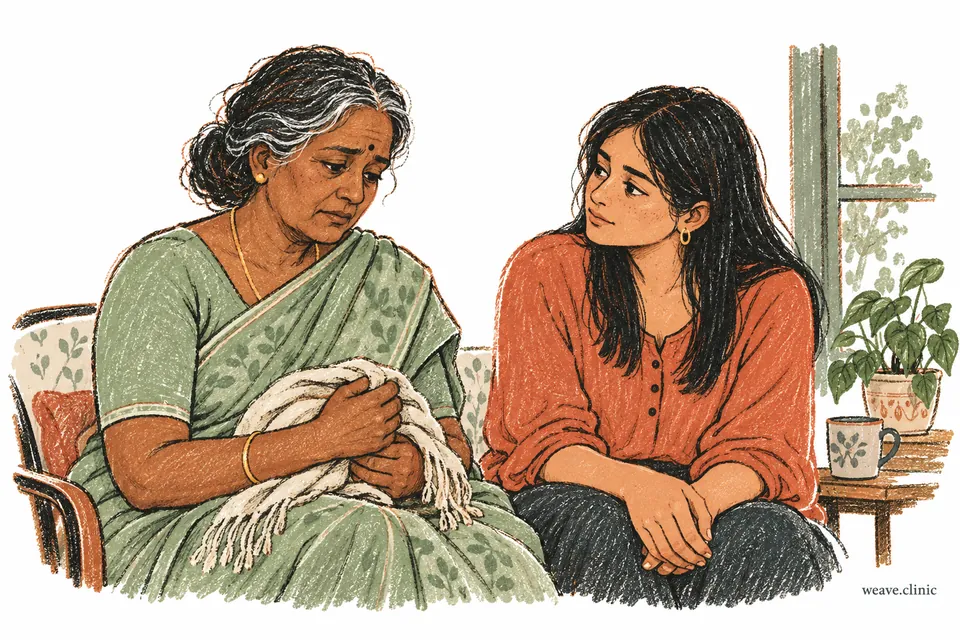
This page is about grief after a death, and about the losses that work like a death even when nobody died.
It is a general guide. It cannot tell you how your own loss will go, and it is not trying to move you along faster.
Grief Is Not An Illness
Grief is what attachment does when the person is gone. It is a normal response to a real loss, not a condition that has arrived on top of it.
Most grief does not need treatment
You do not need a diagnosis to deserve time, help or gentleness. Grief needs support, and it needs room.
Some grief does need help
Grief can become heavy enough to stop a life restarting, and there is help for that. The last part of this page is about how to tell.
Waves, not stages
Where the five stages came from
Denial, anger, bargaining, depression and acceptance. That model came from work with people who were dying, and it was later borrowed and applied to the bereaved.
What the evidence says
It does not support fixed stages passed through in order. Studies of bereaved people find no reliable sequence. Plenty feel several of those things at once, or in a different order, or barely at all.
What people describe far more often is waves. A stretch of days that feel manageable, then something small tips it over.
Over a long time the waves usually come further apart and knock you over less. They do not run to a calendar, and an anniversary or a wedding can bring one back years later.
That is ordinary, and it is not a sign of going backwards.
There is no correct amount of time. Someone telling you it has been long enough is telling you about their own discomfort, not about your loss.
What Grief Can Look Like
Grief is not only sadness. It shows up in four broad places at once, and people are often taken aback by how physical it is.
In the emotions
Sadness, yes, and also anger, guilt, panic, irritability, and stretches of feeling nothing at all. Numbness early on is common, and it is not coldness. It is the mind letting the news in slowly.
In the body
A tight chest. An empty, hollow stomach. Exhaustion that sleep does not touch. Appetite gone or gone strange. Headaches, and getting ill more easily. Grief is physically demanding work.
In the mind
Poor concentration, forgetting simple things, losing the thread mid-sentence. Going over the last days again and again. Reaching for the phone to tell them something before you remember.
In faith and meaning
Some people find their faith holds them steady. Some find it shaken, or find themselves angry at God. Some move between the two in the same week. All of that sits within grief.
Some of the most common reactions are the ones people are most ashamed of.
- Anger, at the hospital, at relatives, at the person who died, at yourself
- Relief, especially after a long illness or a difficult relationship
- Numbness, or getting through the funeral without crying
- Guilt about what you did, what you said, or what you did not get to
- Hearing their voice, sensing them in the room, seeing them briefly in a crowd
- Talking to them out loud, keeping their number, keeping their clothes
- Laughing, and then feeling caught out for laughing
None of these mean something has gone wrong with you. Relief and love sit together more often than anyone says out loud.
Rituals, Family And Community
In most Indian families a death comes with structure. Days that are marked, prayers that are said, people who arrive, food that is cooked and shared, things that a son or a daughter or a neighbour is expected to do.
That structure often helps
It gives grief somewhere to go in the first weeks, it puts other people in the house, and it says plainly that a loss has happened. Rituals also give the community a way to show up.
It can also be a lot
A house full of visitors for days can hold you, or it can leave you doing hospitality while your own grief waits its turn. Both are common, and one does not cancel the other.
Grieving differently from your family
Within one family, people grieve in ways that look nothing alike.
One cries openly
Another goes quiet and pours themselves into work.
One wants to talk about the person constantly
Another finds that unbearable.
These get read as coldness, or as making a scene
They are usually just different shapes of the same loss.
You are allowed to grieve in your own way, including a way your family does not recognise. If you find the rituals steadying, that is worth keeping. If you find parts of them hard, that is worth saying, gently, to someone you trust.
The harder stretch usually comes later. The visitors go home, the rituals finish, everyone else returns to their lives, and the house is quiet. That is often when support drops away and when it is most needed.
What Actually Helps
Time on its own does less than people think. Time with support does the work.
- Company that does not need managing. One or two people you can sit with without performing. Someone who can hear the same story a fourth time without steering you toward the bright side.
- Telling the story. The illness, the phone call, the last conversation, what you wish you had said. Retelling is not dwelling. It is how the mind takes in something it could not take in at once.
- Letting the waves come. Bracing against them takes more energy than riding them. A wave that is allowed to arrive usually passes sooner than one that is fought.
- Small routines. Regular sleep and waking times, food at roughly the same hours, some movement outdoors, even briefly. These sound trivial and they hold more than they look like they should.
- Keeping a place for them. Photographs, a day in the year, cooking something they liked, saying their name in conversation. Continuing the bond is part of grieving, not a failure to let go.
- Practical help, asked for specifically. People want to help and do not know how. "Can you take the paperwork" is easier to answer than "let me know if you need anything".
- Care with alcohol and sleeping tablets. Both take the edge off in the evening and make the following days harder. If either is creeping up, that is worth mentioning to a doctor early.
Some people find a grief group useful, some find one-to-one therapy useful, and many people need neither. Grief is not automatically a job for a clinic.
When It Is Worth Asking For Help
There is no clean line, and the point is not to grade how you are coping. The useful question is whether grief has stopped moving at all, and whether life has been unable to restart in any form.
It is worth talking to a professional when, after many months:
- The pain feels exactly as raw as it did at the start, with no softening at any point
- Life has not restarted in any way, and there has been no return to work, study, or ordinary contact with people
- The longing for the person takes up most of most days and crowds out everything else
- You are avoiding every reminder, including people, places, photographs and conversations, in order to get through
- Basic functioning has gone, and eating, washing, sleeping or caring for dependents are not happening
- Alcohol, cannabis or sedatives have become the way through the evening
- Low mood, hopelessness, or a sense that nothing has meaning has settled in and stayed
Clinicians do have a name for grief that stays stuck in this way, prolonged grief, and it responds to treatment. If you want to know what that work looks like, our page on finding a therapist in Mumbai sets out how it starts.
That name is a description of a pattern, not a judgement on how much you loved someone, and no page can tell you whether it applies to you. That is a conversation with a clinician who has heard your whole story.
If there are thoughts of not wanting to live
After a death, many people say they would not mind if they did not wake up. That thought is common in grief, and it still deserves to be taken seriously rather than sat on alone.
If you are having thoughts of ending your life, or of joining the person who died, please talk to someone today.
- Tele-MANAS is free, open at all hours, and answers in several languages on 14416.
- The crisis lines are listed at the bottom of this page.
- If there is immediate danger to you or to anyone else, call 112.
Our emergency page sets out what to do and who to call.
Grief After Particular Losses
Some losses carry their own weight. A short word on four of them.
The death of a child
This grief is long, and parents often describe it as reorganising a life rather than recovering from an event.
Two parents in the same house frequently grieve out of step, which strains a marriage at the worst possible moment. Support that includes both of you, together and separately, tends to help.
The death of a spouse or partner
Along with the person, a whole daily structure goes: the routines, the conversations at night, the shared decisions, and often the household's finances and social standing.
In many Indian families a widow or widower also faces sudden changes in how relatives behave. Practical help and company in the ordinary hours matter as much as talking about the loss.
Death by suicide
Grief after a suicide carries extra load: unanswerable questions, guilt about what was missed, anger, and in many places a silence around what happened. Families are often left explaining the death to neighbours while still absorbing it themselves.
Two things worth knowing
Nobody has enough information to know what was in another person's mind, so the search for a single reason tends to hurt without settling anything.
And people bereaved by suicide are themselves at higher risk, which is a reason to accept support early rather than a reason for alarm. Support groups for suicide-bereaved families exist in India, and a clinician can help you find one.
Pregnancy loss and stillbirth
A miscarriage, a stillbirth or a neonatal death is a bereavement, even when the people around you treat it as a medical event to be moved past.
Parents often grieve a whole imagined future, and mothers carry a physical recovery at the same time. Being told to try again soon is common and rarely lands well. This loss deserves the same room as any other.
Where To Read Next
Related pages on this site.
- Depression, because grief and depression overlap and are often confused with each other
- Types of therapy, if you are wondering what talking therapy would involve
- Finding care that understands your culture, on family, language and faith in the room
- Sleep, since sleep is one of the first things a loss disturbs
- Emergency and crisis help, if things feel unsafe right now
The Weave Family Library is free, needs no sign-up, and is written in plain language. Its books on depression, trauma and supporting someone you love may be useful while a grief title is being written.
Each book is available in five languages and can be downloaded as a PDF.