The question before the question
Before asking for help, an early-career clinician may have to answer a private question: what will this admission cost? Will the colleague respond to the uncertainty itself, or treat its existence as evidence that the person should not be here?
That calculation can occur in psychiatry, psychology and many other professional settings. It takes energy that might otherwise be spent understanding the work. Over time, a person may learn to ask only questions that demonstrate what they already know.
A culture of impressive questions can look intellectually lively while leaving basic confusion untouched. The uncertainty does not disappear; it becomes harder for supervisors and colleagues to see.
Being early in a career means having less experience. It does not mean having less dignity, and it should not require performing certainty as the admission price for professional belonging.
Asking is a skill worth teaching
A useful request for help can make its purpose clear. It can identify the point of uncertainty, explain what the person has already considered and say what kind of input they need. Those habits make a conversation easier without pretending the question must be perfectly formed.
Sometimes a trainee cannot yet locate the problem precisely. They know that something does not make sense, but lack the experience to name the gap. Helping them turn that unease into a workable question is part of teaching, not an irritating preliminary to it.
A supervisor who asks about the trainee's reasoning can learn more than one who immediately supplies a polished answer. They can see which distinctions are understood, where an assumption entered and what needs further explanation.
The aim is not to make asking effortless or remove the responsibility to prepare. It is to make uncertainty discussable before it has been concealed by a confident presentation.
The answer teaches more than its content
A colleague's response communicates two lessons at once. There is the answer to the immediate question, and there is the lesson about whether another question would be welcome. The second may be remembered longer than the first.
An impatient interruption, a joke at the trainee's expense or a comparison with someone more advanced can turn a teaching moment into a warning. A technically accurate answer does not cancel that effect. Nor does describing the exchange as character building make its cost disappear.
A respectful response can still be demanding. It can ask the trainee to return to a source, clarify an unsupported claim or acknowledge the limit of their competence. These are useful expectations when they are connected to the work rather than to humiliation.
The difference is visible in what happens next. Does the learner leave with a clearer task and a better question, or only with a stronger incentive to avoid being seen struggling?
Peers can help without becoming substitutes
Cross-professional peers can offer valuable company in the early years of practice. A psychiatry trainee and a psychology trainee may recognise similar pressures while having very different experiences of training, supervision and institutional standing.
Talking across that difference can reduce caricature. It may reveal that a colleague's apparent confidence rests on familiarity with one task, while another part of the work is still new to them. No one needs to disclose private difficulties to make the exchange worthwhile.
Peer conversation also has limits. It should not become an informal way to transfer responsibility, replace required supervision or obtain work from a colleague who cannot reasonably refuse. Mutual support depends on being able to say that a question needs someone else's input.
A healthy learning relationship leaves room for generosity and boundaries together. It does not require either person to become endlessly available in order to prove that they are collaborative.
There is pleasure in learning together
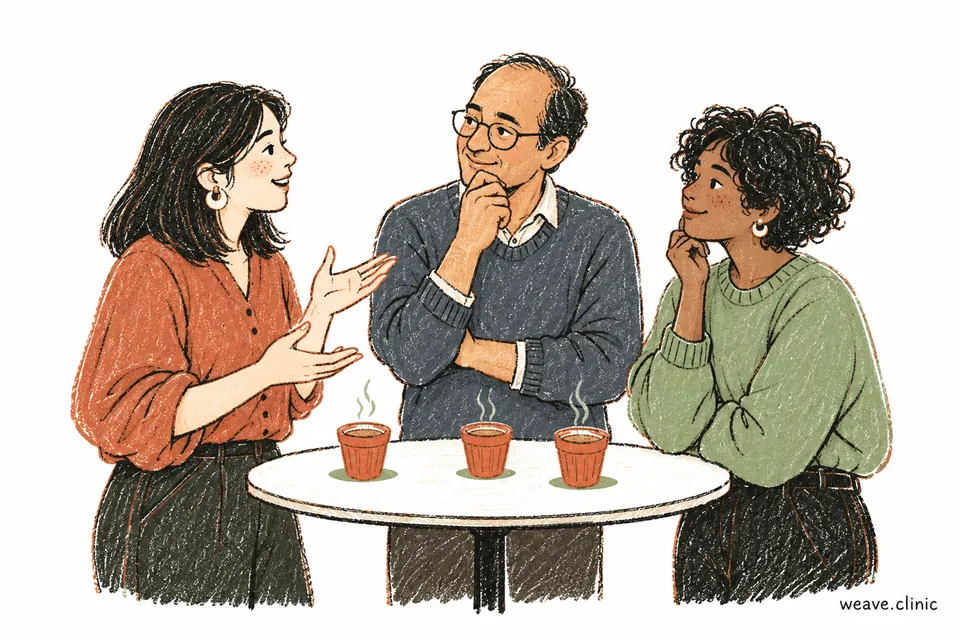
There can be a quiet pleasure in finding a colleague with whom a difficult question becomes easier to think about. A conversation over tea, a useful reading suggestion, or someone remembering to ask how the first week went can make a workplace feel more human. These gestures are small enough to be overlooked and meaningful enough to be remembered.
Neither profession has a monopoly on that generosity. A psychiatrist can make room for a psychologist who is new to a team; a psychologist can help a psychiatry trainee find words for a question they have been struggling to ask. Sometimes the most useful exchange begins with the simple admission that neither person has the answer yet.
That is one part of helping that deserves more space in professional writing: the ordinary willingness to stay interested, offer time, and let another person remain unfinished. It can coexist with demanding standards and clear boundaries. Being a capable clinician need not mean becoming an unapproachable one.
Growth needs conditions, not only courage
Advice to speak up can place the burden on the least powerful person in the room. Courage helps, but it cannot manufacture protected supervision, reasonable access to teaching or a reliable response to concerns. Those are responsibilities of the workplace and its leaders.
Small changes can make those responsibilities more visible: a predictable time for questions, an explanation when a discussion must be deferred and a real opportunity to return to it. A postponed question should not quietly become a question nobody is allowed to ask.
Professional development also includes revising an earlier view without treating the revision as disgrace. An experienced colleague who explains what changed their mind gives a trainee a more useful model than one who presents every conclusion as inevitable.
Thread makes room for writing about this unfinished work. An early-career reflection need not end with mastery. It can end with a clearer limit, a better question or an ordinary moment of learning that deserves to be taken seriously.