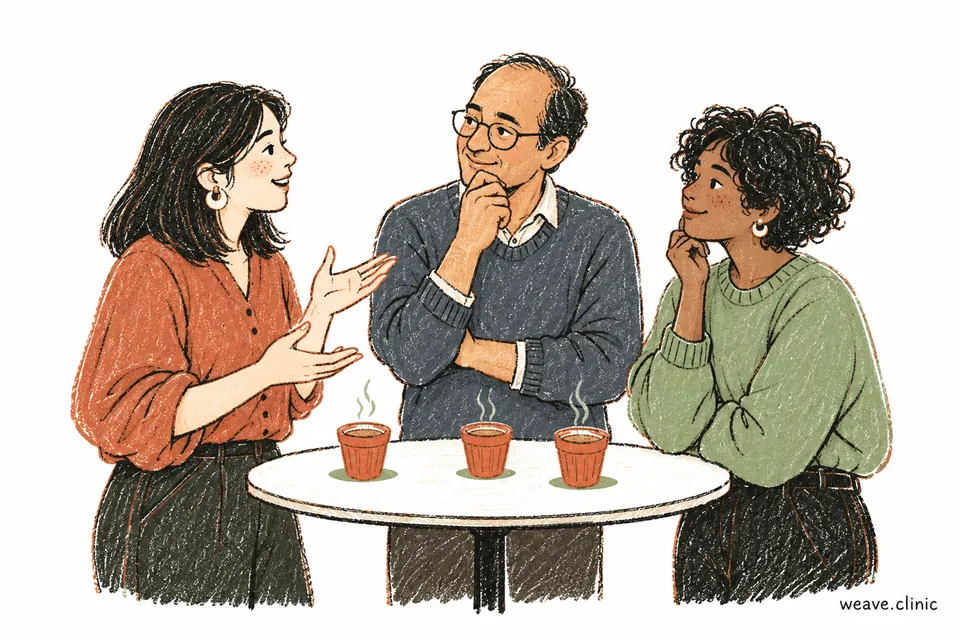
The teaching example in this essay is entirely fictional. It does not describe a real person or a composite case.
A fictional meeting
This is an invented teaching scenario about colleagues in a training discussion. It contains no real or composite patient account and offers no advice for resolving a particular clinical situation.
A psychologist and a psychiatrist are reviewing a fictional service communication exercise. They disagree about the wording of a shared summary. The psychiatrist wants it to communicate a clear direction; the psychologist thinks it presents an unsettled question as if the team has already reached agreement.
Both are concerned about clarity, but they mean different things by it. One wants the reader to understand what happens next.
The other wants the reader to understand what remains uncertain. Their disagreement begins to sound personal before either distinction has been made explicit.
The useful pause comes when they stop defending their preferred wording long enough to identify the separate problems they are trying to solve.
Find the actual point of difference
Disagreement can become larger than its subject. A question about a sentence turns into a judgment about a profession. The medical perspective becomes a shorthand for one position and the psychological perspective for another, even though neither profession is internally uniform.
In the exercise, the colleagues return to the exact sentence. They separate three issues: what the group agrees on, what it has not resolved and what responsibility follows from the discussion. The wording had tried to accomplish all three at once.
This does not make the remaining difference vanish. It makes it possible to discuss without attributing an entire philosophy to the other person. Each can now explain what would be lost if their concern were omitted.
Specificity lowers the temperature because it gives the conversation an object. A colleague can respond to an argument about meaning more usefully than to an accusation that their profession never understands.
Name the effect of hierarchy
The fictional psychiatrist has greater institutional authority in the exercise. That matters even if they sincerely regard the conversation as equal. They can end the discussion more easily, and the psychologist may have more reason to worry about how continued disagreement will be interpreted.
An invitation to speak openly is insufficient if the practical penalty for doing so remains unclear. The person with greater power needs to demonstrate that a concern can be heard without becoming evidence of disloyalty, incompetence or difficult behaviour.
In the exercise, the psychiatrist acknowledges that their preferred wording should not become the default merely because they proposed it. This does not transfer responsibility away from them. It makes the basis of the decision available for discussion.
Power cannot always be removed from a workplace conversation. It can be made less arbitrary by giving reasons, preserving relevant dissent and not treating a professional challenge as a personal offence.
Do not recruit an audience to win
When a disagreement feels uncomfortable, each colleague may be tempted to seek reassurance from others. Advice and supervision can be appropriate, but gathering allies to establish who was unreasonable can turn an unresolved question into a reputational contest.
The exercise distinguishes help with thinking from help with winning. A supervisor could clarify how the discussion should proceed or help examine the competing reasons. They should not be asked to infer a colleague's character from a selective retelling of an argument.
Public commentary brings an additional problem. A supposedly anonymous account may still make a workplace or colleague recognisable, especially when distinctive details accumulate. Thread's fictional scenario avoids using an actual dispute as material for precisely that reason.
A useful reflective essay can explore the pressure to win without staging a public trial. It can examine a pattern of behaviour while resisting the satisfaction of making one identifiable person the example.
Finish honestly, even without agreement
The colleagues in the exercise produce a revised summary that distinguishes the agreed next step from the unresolved question. Neither claims that the disagreement never mattered. They record why the wording changed and identify what would require further discussion within the exercise.
That ending is deliberately limited. Real disagreements can remain serious, and some require formal supervision or the relevant institutional process. A general essay cannot provide a universal script or suggest that a courteous conversation is enough for every concern.
What the fictional meeting illustrates is a smaller possibility: a difference in judgment does not have to become a test of who deserves to be heard. Clarity can include both responsibility and uncertainty without disguising either.
A shared professional culture grows when disagreement leaves the work more understandable. It shrinks when one person leaves victorious and everyone else learns that the safest contribution next time is silence.