
The Parent's Guide
Trauma and its aftermathYour child after something frightening
A warm, plain guide for a parent whose child has been through something frightening and is not the same since, and the calm, steady steps that help a child feel safe again.
Not the same since
If your child went through something frightening and has not been the same since, you are not imagining it. Doctors describe changes like these as a normal response to a frightening event.
Maybe it was a road accident. Maybe it was violence, a fire, a flood, or the sudden death of someone close. Maybe someone hurt your child. Since then, your child seems different, and you do not know how to reach them.
Children show fear in their own way. A child's body and behaviour often say what their words cannot. Guidance for doctors lists some common reactions.
- At night: bad dreams and trouble sleeping.
- In play and thought: playing out the event again and again, and upsetting memories that pop up.
- In the day: avoiding reminders, more difficult behaviour, trouble concentrating, and staying on watch for danger.
There is real hope here. Most children who go through something frightening do not develop lasting stress problems. This booklet will not put a label on your child. Only a doctor can say whether your child needs specialist care. It will help you understand what you see, and respond in ways that help.
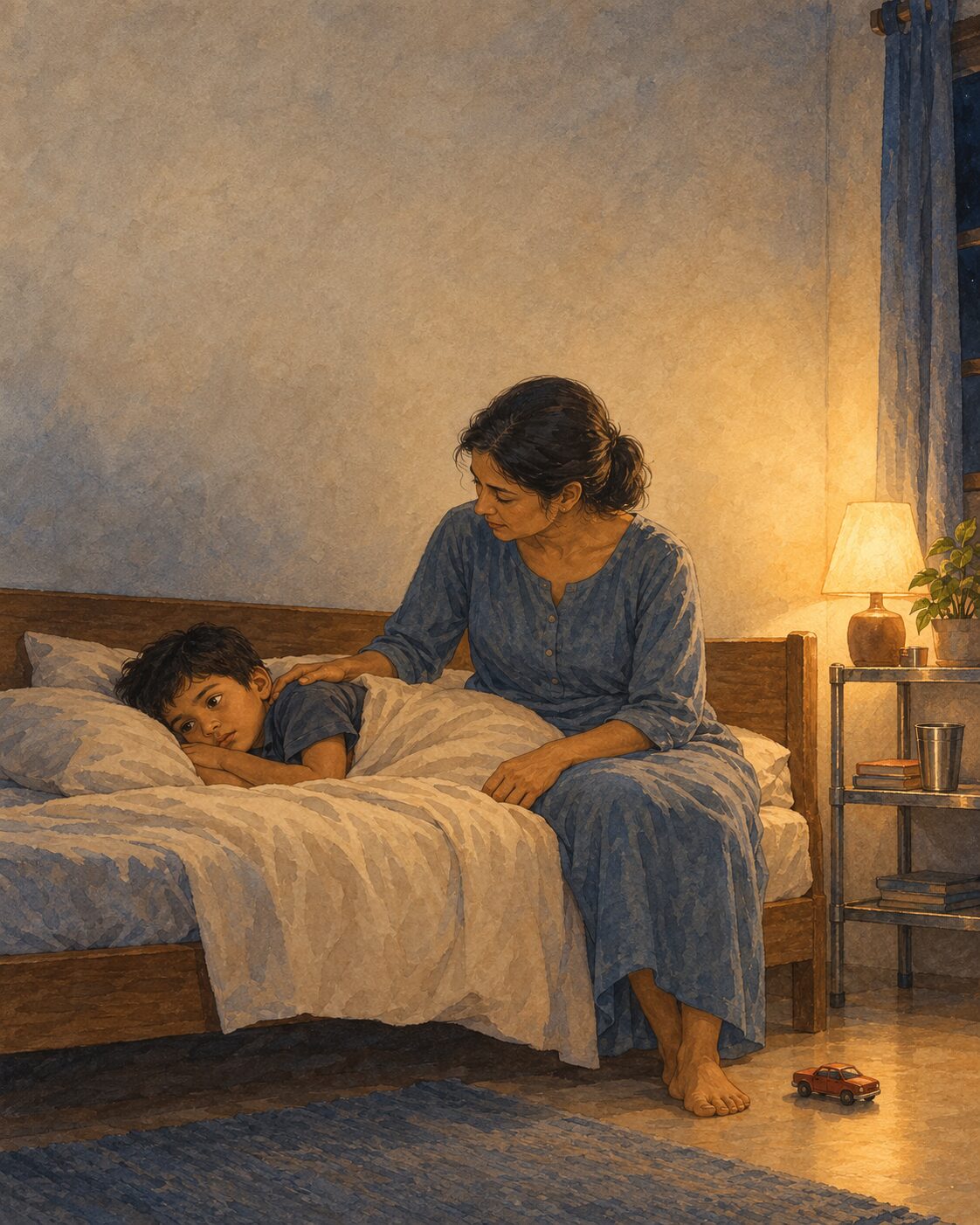
Sunita's son Kabir is nine. Two months ago, the auto-rickshaw taking him to school was hit by a car. Nobody was badly hurt. But Kabir has not slept through the night since. He wakes from bad dreams and climbs into her bed. He will not get into the school van. At home he crashes his toy cars into each other, again and again. His grandmother says he is being spoilt and needs a firm hand. Sunita is not so sure.
She is right to wonder. Kabir is not being naughty. His nightmares, his fear of the van and his crashing games are all signs of a frightened child. Playing out what scared them, again and again, is a common reaction in children.
For three days, just watch and jot it down. When is your child most upset, and what came just before? When are they calm and easy? You are not fixing anything yet. You are learning what sets off the fear.
A frightened alarm, not bad behaviour
After something frightening, a child's inner alarm can stay switched on, as if the danger were still here. That is a normal reaction. It is not naughtiness, not weakness, and not bad parenting.
Picture an alarm inside your child, there to keep them safe. In a frightening moment, it rings loud. After the danger has passed, some children stay on watch for danger, as if the alarm were stuck on. So a door slam may make them jump. A raised voice may bring the fear back.
So when anger, clinging or nightmares come, think of fear first. These are signs of fear, not signs of a bad child. Meet them with comfort before correction.
It is also not your fault. If someone hurt your child, the blame belongs to the person who did it. It does not belong to your child, and it does not belong to you.
Once I saw his tantrums as fear and not cheek, I stopped fighting him and started holding him.
Sunita, mother of Kabir, 9
In many of our homes, the advice comes fast. Do not talk about it. Children forget. Be strict and he will come round. Some of this comes from love. But silence and strictness alone can leave a frightened child alone with the fear.
Not every child needs treatment straight away. In the first month, doctors may suggest watching closely, with a planned check-in within that month. Children who keep struggling need specialist help. The last section of this booklet explains when.
More, if you want it
Some children were hurt on purpose by another person, as in violence or abuse. In one large review, they were at higher risk of lasting stress problems, and so were girls. None of this is a verdict on your child. It only tells you who needs closer watching and earlier help.
The next time your child explodes or clings, say inside: this is fear, not defiance. Let your own shoulders drop. Your calm is a good first step.
Calm, steady and close
Good help at home is simple. Stay calm, keep the days predictable, listen when your child wants to talk, and never force them to tell the story.
A frightened child needs to feel safe again, many times over, in small ways. You do not need one big talk. You need many ordinary moments that say: you are safe now, and I am here. Show safety again and again, in small, ordinary ways.
- Steady yourself first, so your child can borrow your calm.
- Keep meals, school and bedtime at the same times each day.
- Listen when they want to talk, but never force the story.
- Name the feeling, and say plainly that they are safe now.
Keep your words short, true and calm. You might say, "That was very scary. You are safe now. I am here." Or, "Lots of children feel jumpy after something like that. We will get through this together." If your child asks questions, answer simply and honestly, at their level.
Just as important is what not to do. Do not make your child tell the story again and again, to you or to relatives. Doctors who care for abused children are asked to keep retelling to a minimum, because it can hurt the child again. Do not press for details or quiz them about what happened. Let them lead. Some children show what happened through drawing, writing or toys, and that is fine.
One more move can help: routine. Try to keep meals, school, play and bedtime regular, so each day feels familiar. Give a little warning before any change. Keep goodbyes short and warm, and always come back when you said you would.
More, if you want it
Let the class teacher know, briefly, that your child went through something hard. You do not need to share details. Ask the teacher to tell you about changes in mood, sleepiness or marks. Help your child back into the normal school day, gently. If your child cannot manage school at all after a few weeks, that is a sign to talk to a doctor.
Remember
Your child does not need perfect words from you. They need your calm face, your steady voice, and the same bedtime as yesterday. Small and steady is enough.
Choose one part of the day that has become hard, say bedtime. Make it the same every night this week: same time, same steps, same goodnight words. Then notice whether it gets a little easier.
Safety comes first
If the harm came from a person, the first job is to keep your child safe from them. Listen without judging, tell them it is not their fault, and get help from people trained to protect children.
Some children are hurt by another person. It may be a stranger, or someone the family knows and trusts. That can make it hard to believe, and hard to act. If your child tells you someone hurt them, take it seriously, and keep them away from that person.
Stay calm in front of your child, even if you feel shock or rage inside. You might say, "Thank you for telling me. You did the right thing. It is not your fault. I will keep you safe." Do not ask for every detail. Trained people will ask what they need to, in the right way. They should also tell you what changes to watch for in the coming weeks, and when to seek more help.

Rekha's daughter Anjali is twelve. One evening, Anjali told her mother that a relative had been hurting her when the adults were not around. Rekha's first thought was that it could not be true. Some elders in the family said to keep it quiet, for the family's name. Rekha chose to believe her daughter. She kept the relative away from the house. Then she called the child helpline, 1098, and they guided her through the next steps.
Here is what the law says, in plain words. In India, the POCSO Act protects children under 18 from sexual abuse. Anyone who knows a child has been sexually abused, or fears it is likely to happen, must tell the police. This is a duty, not a favour, and it applies to everyone, including doctors, teachers and the family. A person who tells the police honestly cannot be sued or charged for doing so. The law also protects the child's privacy: the media cannot publish the child's name or details, and the police and the court must keep the child's identity safe.
The child helpline, 1098, is free and open day and night, for any child in a difficult situation. In an emergency you can also call 112. The helpline can link a child to medical care, shelter, legal aid and emotional support. This booklet cannot give legal advice. The helpline, the police or a lawyer can explain each step.
More, if you want it
Many families fear what people will say. Log kya kahenge. Keeping quiet can feel like protecting the family. But silence can leave your child unprotected. Speaking up is how you protect your child. It also shows your child that you are on their side.
Save 1098 in your phone today, next to the number of your child's doctor. If you ever need it, you will not have to search for it in a panic.
Your own fear counts too
When your child is hurt, you are hurt too. Your shock, guilt and fear are real, and you may need support of your own. Looking after yourself is not selfish. It is part of helping your child.
Parents can carry their own reactions after a child's frightening event. You may replay it at night. You may feel jumpy, angry or numb. You may even have been there yourself, in the same accident or the same flood. Your own care is part of your child's care.
You may feel guilty, especially after abuse. Why did I not see it? Why did I trust that person? Hear this clearly. You did not cause this. You cannot undo it. But you can help.
In a joint family the pressure can pile up. One relative says forget it. Another blames you. Another wants it all kept quiet. You do not have to win every argument. A short, steady line helps: "We are following the doctor's advice, and we are keeping her safe."
More, if you want it
Find one person who is on your side: your partner, a sister, a friend, a counsellor. Say the hard part out loud to someone who does not judge. If your own sleep, mood or temper stay badly shaken for weeks, see a doctor for yourself too. Help for you is help for your child.
In your corner
On the nights when you lie awake going over everything, hear this: a parent who reads a whole booklet to help their child is not failing. You are standing between your child and the fear. That is exactly where a parent belongs.
Tonight, do one small thing for your own body: a slow walk, an early night, a cup of tea in quiet. Do the same tomorrow. A steadier you is part of your child's recovery.
When it needs specialist help
If the changes last more than about a month, it is time to see a doctor. Go sooner if things are getting worse. The main treatment guidelines recommend is a talking therapy that focuses on the trauma.
Watch how things go over the first few weeks. Then see a doctor if any of these are true.
- The nightmares, fear or anger last longer than about a month.
- Things are getting worse, not slowly better.
- Your child cannot go to school, sleep or eat properly.
- Your child was abused, or still does not feel safe.
For children aged 7 to 17 who keep struggling, guidelines recommend a talking therapy called trauma-focused CBT. For 5 and 6 year olds, they suggest considering it. A trained therapist helps your child learn about fear reactions and ways to calm the body. Then the therapist helps your child work through the memory and stop avoiding reminders. Parents take part where it suits the child. The therapy is shaped to your child's age and stage.
What about medicine? For children and teenagers, medicine is not the usual treatment for these trauma reactions. Talking therapy comes first. If your child also has a heavy low mood or another problem, a doctor will weigh the options carefully with you.
Remember
A good clinician looks at the whole child: sleep, school, friends, mood and family. They will not force your child to relive the event before they are ready. You stay part of every decision.
More, if you want it
You do not need every answer before the first visit. Bring what you have noticed: when the fear is worst, what sets it off, and what helps a little. For some children aged 7 to 17, a doctor may consider another therapy, called EMDR. This is only when more than 3 months have passed since the event, and trauma-focused CBT has not helped or your child could not take part in it. Asking for help early is not overreacting. It is good parenting.
Some signs mean act now, not later. Trust your instinct here. It is better to get help you did not strictly need than to miss a moment that mattered.
Talk of dying or self-harm.
Any talk of not wanting to live, or of hurting themselves, needs help the same day.
Not safe yet.
If the person who hurt your child can still reach them, act now to keep them away.
Not eating, not sleeping.
Days without food, water or sleep need a doctor quickly.
Cannot be reached.
If your child seems lost in the memory and nothing calms them, get help.
If you think your child is in danger right now, do not wait. Call 112, or go to the nearest hospital emergency. Stay with them, and reduce access to things that could be used to hurt themselves. Tele-MANAS, 14416, is a free government mental-health helpline, open day and night. If you are worried, ask your child gently and directly whether they have thoughts of hurting themselves. In a review of studies in teenagers and adults, asking about suicidal thoughts did not increase them. Help is there, and you do not have to face this alone.
The child who is frightened today can, with a steady parent and the right help, feel safe in the world again.
Write down the two or three changes that worry you most, with one real example of each. Keep the list on your phone, beside 1098 and Tele-MANAS, 14416. Having it ready makes the first call, and the first appointment, much easier.
Where this comes from
This guide helps you recognise and understand. It is not a diagnosis. For that, see a professional.