
The Parent's Guide
Self-harmWhen your child is hurting themselves
A calm, practical guide for a parent who has found out, or fears, that their child is hurting themselves: how to tell hurting to cope apart from wanting to escape life, how to talk without panic, how to make the home safer, and how to get help.
The floor drops away
If you have just learned that your child is hurting themselves, the fear you feel right now is enormous, and it is normal. You are not a bad parent. This is more common than most families ever say aloud, and only a doctor can tell you how much danger there is.
Maybe you saw a mark you were not meant to see. Maybe your teenager said something, or a teacher called, or you simply have a heavy feeling that something is wrong. Whatever brought you here, the ground has probably dropped away under you, and your mind is racing between panic, guilt, and a desperate need to fix this tonight.
Take one breath. You do not have to have the perfect words this minute. What your child needs first is not a flawless response, it is a parent who stays. Finding out is frightening, but it is also the moment help can begin.
This is far more common than the silence around it suggests. Among teenagers, close to one in six has hurt themselves at some point, and it happens across the age range, in children, teens, and young adults alike. Your child is not the only one, and you are not the only parent sitting where you are sitting now.
Please hear this clearly, because the guilt will try to drown it out. A child who hurts themselves is not proof that you failed them. Self-harm grows out of many things at once, pain, pressure, temperament, things happening inside and around your child, and it is not a simple report card on your parenting.
The other thing to hold onto is that you cannot measure the danger yourself, and you are not meant to. Only a clinician can properly assess how much risk your child is in and what kind of help fits. This booklet will not put a label on your child. It will help you see what is happening more clearly and respond in a way that actually helps.
The bravest thing a frightened parent does is stay calm enough to stay close.
Before anything else, steady yourself. Sit down, breathe slowly for one minute, and say inside: my child is hurting, and I am here, and we can get help. You will respond far better from that place than from panic. Your calm is the first thing that helps.
Not one thing, but two
Self-harm and wanting to die are related but different. Some young people hurt themselves to cope with unbearable feelings, with no wish to die. Others have thoughts of ending their life. Both are serious, both need help, and telling them apart gently is part of getting the right support.
This is one of the most important things a parent can understand. When a young person hurts themselves, it does not automatically mean they want to die. For many, self-harm is a way to cope, a way to get relief from pain that feels unbearable, not an attempt to end life. Wanting to escape life is a different thing, with a different weight and a different response.
These two can overlap, and a young person can move between them, which is exactly why you should never assume you know which one it is. Both are serious, both deserve help, and only a clinician can tell you how much danger your child is in.
You do not sort this out by interrogating your child. You learn it gently, over time, by staying close and asking with care, and by letting a doctor make the real assessment. The picture below is only to help you hold the difference in your mind.
- Hurting to cope is about getting relief or a sense of control, not about wanting to die.
- Wanting to escape life is about thoughts of dying, or feeling there is no way out.
- The two can overlap, and a young person can move between them, so never assume.
- You do not decide which it is; you stay close, ask gently, and let a doctor assess.
Remember
You are not trying to diagnose your child or catch them out. You are trying to understand enough to keep them safe and to get them to the right help. Holding the difference between hurting to cope and wanting to escape life helps you ask better questions and panic less.
Why a young person hurts themselves
For most young people, hurting themselves is a way to manage pain they do not know how else to carry: to get relief, to feel some control, or to let out what they cannot say. It is not attention-seeking, not manipulation, and not a phase to ignore.
When you can bear to ask why, the answer is almost never what parents fear. Young people who hurt themselves usually describe it as a way to cope with overwhelming feelings, to get a moment of relief from pain that feels unbearable, to feel some control when everything else feels out of control, or to show on the outside what they cannot put into words.
This is the part that changes how you respond. The pain your child is carrying is real, and the self-harm is their attempt to survive it, not to hurt you. Understanding that softens the anger and the fear, and lets you meet your child instead of fighting them.
It is worth naming plainly what this is not. It is not your child being dramatic for attention. It is not manipulation. And it is not something to wait out and hope disappears on its own. Dismissing it as any of those keeps a child alone with pain that is already too heavy.
Once I understood he was trying to cope and not trying to punish me, I could finally be on his side.
a parent, six months on
More, if you want it
If your child ever does seem to seek a reaction, that too is worth hearing, not scolding. A young person who has to hurt themselves to be noticed is telling you, in the only language that felt loud enough, that something hurts and they do not feel heard. The answer to that is more connection, not less. You are not rewarding the behaviour by responding with warmth; you are answering the need underneath it, which is the thing that actually lowers it over time.
The next time you feel anger or panic rising, silently name what is underneath your child's behaviour: this is pain, not defiance. It will not make you soft or permissive. It will make you the steady adult your child can turn toward instead of hide from.
Staying calm, asking gently
Stay calm. No panic, no punishment, no shame. Ask directly and gently, listen far more than you fix, and validate the pain even as you never approve of the harm. Asking a young person about self-harm or suicide does not put the idea in their head.
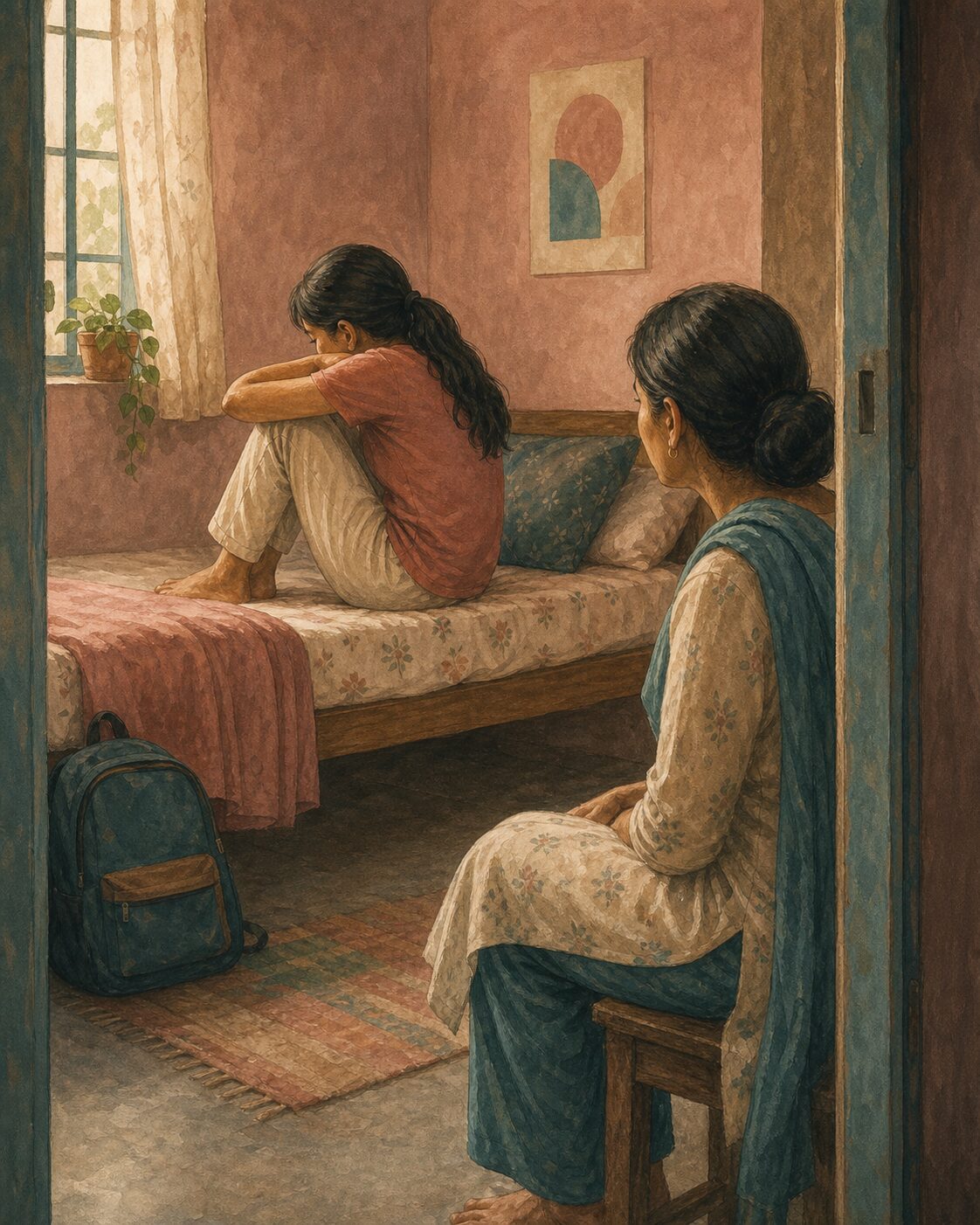
How you first respond matters more than any single sentence. A young person who is met with shouting, punishment, or horror learns that this is a secret to hide better, not a pain to share. A young person who is met with a steady, loving parent learns that they can be honest and still be held. You will not always feel calm; you only have to act calm enough to keep the door open.
Here is a fear almost every parent has, and here is the truth about it. Many parents worry that asking directly about self-harm or about thoughts of dying will put the idea into their child's head. It does not. Careful reviews of the research find that asking does not plant the thought or raise the risk, and being asked can actually bring relief. Asking gently and directly does not create the danger; it opens a door your child may have been waiting for.
So ask, plainly and warmly. You might say, "I have noticed you have been really struggling, and I love you. Have you been hurting yourself?" And, if your worry goes further, "Sometimes when people hurt this much, they have thoughts of not wanting to be here. Are you having thoughts like that?" Then stop, and let your child answer without rushing to fix it.
Listen more than you fix.
Let your child talk. You do not need the perfect solution in the room, only to hear them and stay.
Validate the pain, not the harm.
"I can see how much you are hurting" is true and safe. You never have to approve of the self-harm to love the child.
Stay steady, not shocked.
A calm face tells your child they can say hard things and still be safe with you.
Do not promise secrecy.
You can be trusted and still bring in a doctor. "We will face this together" is the promise to make.
Remember
You do not have to say the perfect thing. What your child will remember is not your words but your face: whether you stayed calm, stayed close, and did not turn away. Presence is the message. You can always say, "I do not have all the answers, but I am not going anywhere."
Practise one gentle sentence out loud when you are alone, so it comes more easily when it matters: "I love you, I am not angry, and I want to understand what you are going through." Saying it once in private makes it far easier to say warmly when your child is in front of you.
Lowering the risk at home
While things are hard, you can make the home safer. Keeping medicines and sharp items secured and out of easy reach during the hardest periods lowers the risk. This supports professional help, it does not replace it, and a real safety plan is built with a clinician.
There is one quiet, practical thing that helps, and the research is clear about it: reducing easy access to dangerous things during the hardest stretches lowers the chance of serious harm, because many of the worst moments pass if a young person cannot act on them instantly. This is not about turning your home into a locked ward or watching your child every second. It is about sensible, caring steps during a hard season.
In practice that means keeping medicines stored safely and out of easy reach, keeping sharp items and other risky things secured, and being thoughtful about what is left lying around while your child is struggling. Putting a little time and distance between your child and danger is one of the most protective things you can do. Do it calmly and without drama, the way you would child-proof a home, not as a punishment or an accusation.
This supports help, it does not replace it
Making the home safer buys time and lowers risk, but it is not the whole answer, and it is not a substitute for professional care. A proper safety plan, what your child can do and who they can turn to when the feelings peak, is built together with a clinician who knows your child. Your job at home is to reduce easy access and stay close; the plan itself is made with a doctor.
More, if you want it
You do not have to get this perfectly right or lock away every object in the house, and trying to control everything will exhaust you and strain the relationship you most need to keep. Focus on the highest-risk things, medicines and obviously dangerous items, during the hardest periods, and let the clinician guide the rest. Keep talking to your child about it openly and kindly, so it feels like care, not surveillance. Safety and trust grow together, not against each other.
This week, quietly do one thing: secure the medicines in your home so they are not in easy reach, and note who in the family knows where the key or safe place is. One calm, practical step, done without fuss, is real protection and a weight off your own mind.
You, and the whole family
Living with this is frightening and exhausting, and the way you respond genuinely matters, so you have to be looked after too. Your own fear, the other children in the house, and your need for support are all part of the picture.
A parent walking through this carries a heavy, constant fear, and often broken sleep, guilt, and a mind that will not switch off. That is not weakness. It is what love looks like under this much strain. And it matters that you are supported, because a calm, warm, steady parent is part of what helps a child recover: how a family responds genuinely changes the road ahead. Looking after yourself is not selfish; it is part of keeping your child safe.
You cannot pour from an empty cup for months on end. Find one person who is on your side, a partner, a sibling, a friend, another parent who understands, and say the frightening part out loud to them. The fear grows heavier in silence and lighter when it is shared. You are allowed to need help for yourself, not only for your child.
Do not forget the other children in the house. Brothers and sisters often sense that something is very wrong, feel frightened or pushed aside, and stay quiet so as not to add to the load. A few honest, age-appropriate words help: that their sibling is going through a hard time, that the adults are getting help, and that they are loved and safe. They do not need every detail. They need to know they have not been forgotten.
In your corner
On the nights when you lie awake terrified, replaying everything you did or did not do, hear this: a parent who is reading a whole booklet to understand and protect their child is not a failure. You are doing the hardest thing a parent can do, and you are doing it with love. Be as gentle with yourself as you are trying to be with your child.
Tonight, name one person you can lean on, and send them a short honest message, even just "I am going through something hard with my child and I need to not be alone with it." Reaching out for yourself is not a detour from helping your child. It is part of it.
Warning signs, and getting help
Some signs mean act now: talk of a plan or of ending their life, saying goodbye or giving things away, a sudden calm after deep despair. In immediate danger, go to a doctor or emergency now, or call Tele-MANAS on 14416. Ongoing help genuinely works.
Most of the time, your job is to stay close and stay in touch with your child's clinician. But some signs mean the danger may be immediate, and you should act straight away, not wait. Trust your instinct here; it is better to seek help you did not strictly need than to miss a moment that mattered.
Talk of dying or a plan.
Any mention of ending their life, or of how they might, is a reason to get help now.
Saying goodbye.
Giving away things they care about, or writing or saying farewell messages.
A sudden, unexplained calm.
A strange peace after deep despair can mean a decision has been made, not that things are better.
The means and the intent together.
Seeking out dangerous things alongside hopeless talk. Do not wait to be sure.
If you believe your child is in immediate danger, treat it like any other emergency. Do not leave them alone, remove access to anything dangerous, and get help right away: go to your nearest doctor or hospital emergency, or call Tele-MANAS, India's free national mental-health helpline, on 14416, any time, day or night. You can call it for guidance for yourself too, not only in a crisis.
Beyond the emergencies, hold onto this: help for young people who hurt themselves genuinely works. Talking therapies designed for exactly this are proven to reduce self-harm and to help young people through, and a clinician builds a plan together with your family. Reaching out early opens more doors, and you are not expected to carry this alone or to be your child's therapist. Your part is to love them, keep them safer, and walk beside them to the help that works.
Getting help together
A doctor or counsellor does not just talk to your child alone and shut you out. Good care for a young person usually includes the family, gives you things to do at home, and treats you as part of the team. Walking in with what you have noticed, calmly written down, turns a frightening appointment into a working partnership.
The child who is hurting today can, with help and time and a parent who stayed, find another way to carry the pain, and grow beyond it.
Write down, on your phone, the two or three things that worry you most, with one real example of each, and keep the Tele-MANAS number 14416 saved beside them. Having both ready makes the first call, and the first appointment, far calmer and far more useful.
Where this comes from
Further reading
This guide helps you recognise and understand. It is not a diagnosis. For that, see a professional.