
The Partner's Guide
Unusual experiencesLoving someone through unusual experiences
A warm, practical guide for the husband, wife or partner of someone going through unusual experiences: how to respond without arguing or agreeing, look after yourself, and get help fast.
When the world starts to look different to them
If your partner has started hearing, seeing or believing things you cannot share, you are not imagining it. You are not overreacting either. Something real is happening, it has a name, and there is help for both of you.
Sunita noticed the small things first. Rahul stopped sleeping. He began checking the window late at night. Then one evening he told her, very calmly, that the neighbours were listening to their phone calls. Nothing she said could shake it, and she felt the ground move under her own feet.
Your story may look different, but the shape is often the same. Your partner may hear a voice when no one is there. They may feel sure of something you cannot see. To them it can feel very real, and that can be frightening for you both.
Naming the pattern can bring relief. A name means it can be understood and treated, not just endured. The clinical name you may hear is psychosis. Only a doctor can say whether it applies, and this booklet puts no label on your partner.
Reading this does not make you their doctor or their therapist. It makes you a partner who understands more. That is one of the kindest things you can bring home.
What it is, and what it is not
These experiences are a health problem, not a flaw in your partner. The behaviour is the illness talking. It is not a message about how much they love you, even when the belief is about you.
One way to picture it is a quiet alarm-and-meaning system in the brain. It decides what deserves attention and what things mean. When it runs too high, ordinary things can feel loaded with meaning or threat. Heavy stress, lack of sleep, heavy drinking or drug use can set off an episode in some people.
It is not possession, a punishment or a weak character. Violence is fairly uncommon in people going through this. They are more likely to be hurt by others than to be violent themselves. The behaviour is the illness talking, not a message about how much they love you.
When he accused me of plotting against him, it broke my heart. Months later he told me he had been terrified the whole time. It was never really about me.
Kavita, wife, 38
Sometimes the belief is about you. Your partner may suspect you, accuse you, or stop trusting your cooking or your phone. That hurts in a way few people understand. It helps to remember that the fear came first, and you were pulled into its story.
You did not cause this, and you cannot cure it on your own. But what you do can help. When families take part in care, relapses may come less often. With treatment, recovery is often possible, and early treatment can work better.
More, if you want it
Separating the illness from the person does not mean excusing everything. The hurt is real, and so is the load. It means you stop fighting a person you no longer recognise, and start working on a problem you can share. "This is the illness, and we are on the same side of it" is a sentence you can both stand next to, once things are calmer.
For a few days, just notice, without bringing it up. When do the experiences seem louder, and when do they seem quieter? What happens to sleep, stress and time alone before a hard day? You are not fixing anything yet. You are learning the shape of what you are both living with.
The loop you keep repeating
Many couples slide into the same loop. A belief takes hold, you argue with it, your partner feels disbelieved and more alone, and the belief grows stronger. Nobody chooses this loop, and either of you can step out of it.
The loop starts with love. Your partner says something that cannot be true, and you rush to correct it. You show proof. Your voice rises a little. You are trying to bring them back to you.
But from inside the experience, it feels real. So your arguing lands as "you do not believe me", or worse, "you are part of it". Your partner feels more alone, hides more, and the belief digs in deeper. Then you watch more closely and worry more, and the heat in the home rises.
- A belief or experience takes hold, and it feels completely real to your partner.
- You argue, correct, or show proof, because you want them back.
- They feel disbelieved and alone, so they hide it and pull away.
- You watch more closely and worry more, and the belief grows stronger.
The heat matters. Research shows that a lot of criticism, hostility or anxious over-involvement at home is linked to more relapses. This is not about blame. It can happen in any frightened, loving family under strain. It means a calmer home is linked to fewer relapses, and a calmer home is something you can build.
There is a second trap too. To keep the peace, some partners start agreeing with the belief. That can feel kind, but it means saying something you do not believe. The way out sits in the middle: you do not argue, and you do not agree.
Next time you feel the loop starting, pause before you correct. Take one breath and say, "I can see how frightening this is for you." Notice what changes when you answer the feeling instead of the belief.
What actually helps, and what backfires
Talk to the feeling, not the belief. Keep the home calm and low-key. Plan for hard days together while things are steady. And stay with treatment as a team.
Talk to the feeling, not the belief. You might say, "I do not see it the same way, but I believe it feels real to you. That sounds frightening." This is honest, and it keeps you on their side. You do not have to win the argument to stay close.
Lower the heat at home. Use short, simple sentences, with one person speaking at a time. Give space when they need it, and keep the day's rhythm steady. Protect sleep, because lack of sleep can set off an episode in some people.

Family sessions can include planning how to handle a future hard spell. You can start that plan yourselves. Sit down together in a calm week. Write down the changes each of you noticed last time, such as sleep breaking up, pulling away, or suspicion creeping back. Then agree on what you will both do when you see them, such as calling the doctor. A plan your partner helped write can feel like theirs, not something done to them.
Stay with treatment as a team. In studies, people who stayed on their medicine once they were stable had far fewer relapses than people who stopped it. Guidelines ask that any stopping is planned with the doctor, done slowly, and watched for early signs. If side effects are bothering your partner, talk to the doctor together rather than stopping in secret.
Some families feel that hiding medicine in food or tea is the only way. Please do not do this without the doctor. If it is found, it can break trust badly. Speak openly with the doctor about what is happening at home, and ask about other options, such as medicine given as an injection every few weeks.
Remember
Answer the feeling, not the belief. Keep the home calm and the sleep steady. Know the early signs before you need them. And keep the door to treatment open, together, even on the days it feels like a fight.
Learning together helps too. Family sessions with a doctor or therapist may lower relapses and hospital stays. Ask the doctor whether such sessions are available for you both. You are not a passenger in their treatment. You are part of it.
This week, pick the one early sign that worries you most, perhaps sleep. Agree on one small step together, such as telling each other when sleep slips for two nights. One shared signal, made while things are calm, is worth more than a hundred reminders in a storm.
Staying in their corner without losing yourself
You cannot pour from an empty cup. Living alongside these experiences is hard, and looking after yourself is not selfish. It keeps you able to keep showing up on a long road.
You cannot pour from an empty cup. Caring for someone through these experiences can place a real strain on any family. Guidelines say carers should be offered education and support of their own, as early as possible. Looking after yourself is part of the care, not a break from it.
Keep your own life running. Your work, your friends, your rest and one thing that is just yours still matter. They stop the whole marriage from becoming about the illness.
Boundaries are an act of love. It is fair to say what you can and cannot do, around money, sleep and your own rest. Your safety counts too. If you ever feel unsafe, step away, stay with someone you trust, and call for help. In an emergency, call 112.
The marriage can change during and after an episode. You may notice closeness, touch or desire dropping for a while. There can be many reasons, and one is that some medicines can lower sex drive. Talk about it gently, and raise it with the doctor, because there may be another medicine with fewer side effects. Start small, with a walk or a meal together, and let the rest return slowly. One hard season need not end a marriage.
Relatives may step in fast, and not always kindly. Some may push you to hide it, worried about log kya kahenge. In one Indian study, almost half of family carers felt uncomfortable telling others about their relative's illness. Some relatives suggest a puja or a healer instead of a doctor. If faith comforts you both, it can sit alongside medical care, not in place of it. Tell the doctor about any other remedies you are trying. A short, steady line helps: "We are working on this together, with a doctor's help."
More, if you want it
Find one person who is on your side, a sister, a friend, someone who will not judge. Saying the hard part out loud takes weight off your chest. Resentment and loneliness grow in silence. A rested, steadier you is the best thing the marriage has.
This week, choose one thing that is only for you: half an hour with a book, a call to a friend, a walk without your phone. Take it without guilt. Notice that the house does not fall apart, and that you come back a little steadier.
When to step in, and getting help fast
Some signs mean act now, not later. If you are ever worried about their safety, or your own, take it seriously, ask plainly, and do not handle it alone. Help is there for both of you.
Some signs mean act now. Watch for no sleep for several nights, or not eating or drinking. Watch for voices telling them to do things, or acting on a belief in risky ways. Watch for talk of death or of not wanting to be here. Do not wait these out. Get help the same day.
People going through these experiences have a higher than average risk of self-harm and suicide. If you are worried, ask plainly whether they are thinking of ending their life. Asking does not put the idea there. Talking about it openly may even ease it.
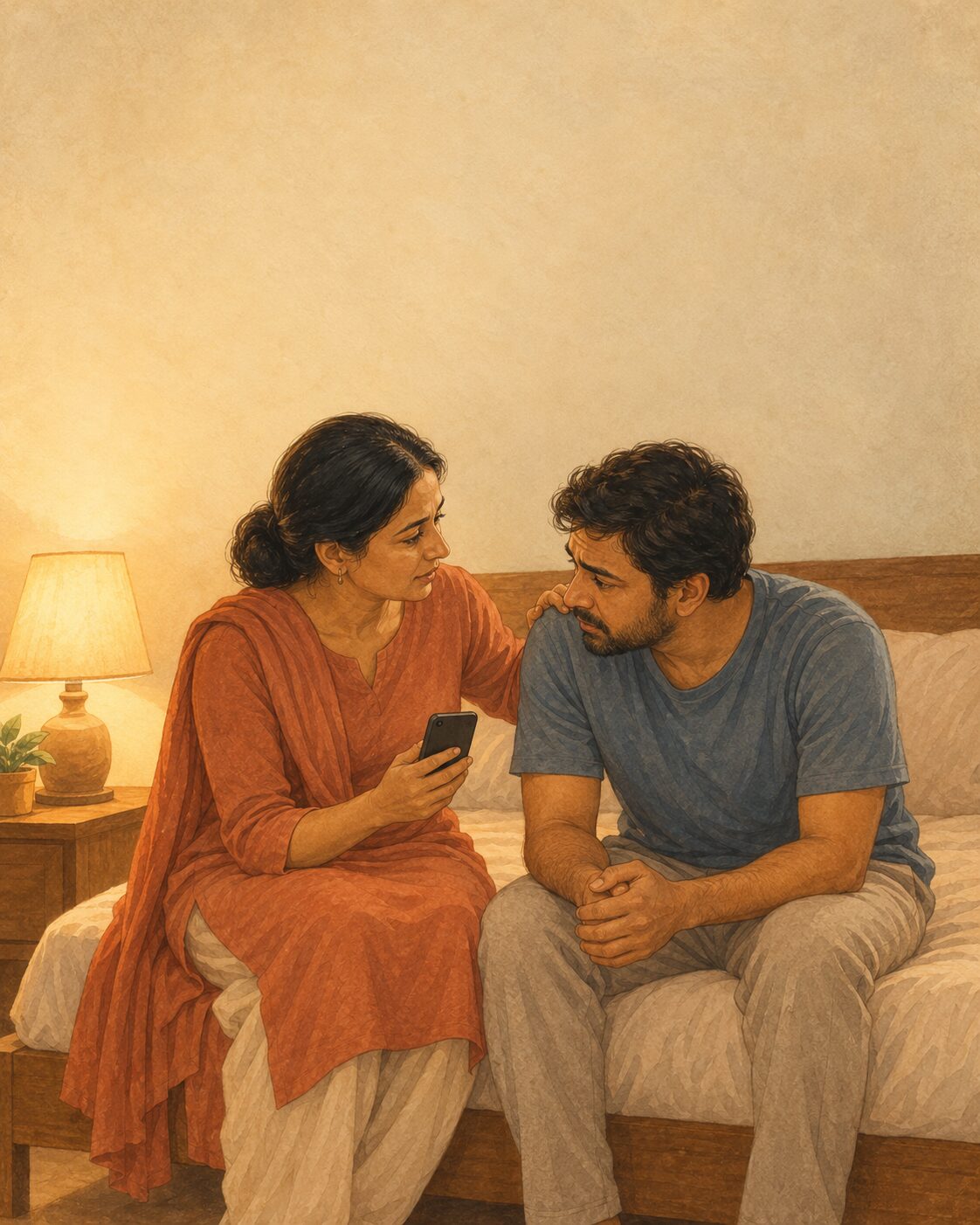
If the danger signs are here, stay calm and speak simply. You might say, "I can see you are frightened, and I want to keep you safe. Let us call the doctor together." This is not the moment to argue with the belief. Stay close if you are worried, and help reduce access to things that could be used to hurt themselves. If it cannot wait, take them to the nearest hospital emergency if they agree, or call 112.
Tele-MANAS, 14416, is a free government mental health helpline, open 24 hours a day. Anyone can call, including you as the partner. A trained counsellor answers and can link you to further help.
Get them to a doctor early, because early treatment can work better. Between crises, help them stay connected to care. Keep appointments, and reach out as soon as the early signs show.
In your corner
If the strain ever tips into "I cannot keep doing this", that feeling is understandable, and help is within reach. It is not a verdict on your marriage. Tele-MANAS on 14416, and the crisis card linked below, have people you can talk to, any time, for either of you.
You do not have to hold all of this by yourself, and you were never meant to. The strongest thing you can do is reach for help early, together, and keep reaching.
The same partner whose world turned frightening can find steady ground again, once the two of you stop arguing about the story and start facing the fear together.
Tonight, save two things on your phone. First, Tele-MANAS, 14416, so it is there before you need it. Second, one early sign you both agreed to watch for, and the small step you will take when you see it. One move toward help and one toward each other is how the long road gets easier.
Where this comes from
This guide helps you recognise and understand. It is not a diagnosis. For that, see a professional.