
The Parent's Guide
Food and eatingWhen your child is struggling with food
A warm, plain guide for a parent whose teenager has started to fear food, hide their eating or chase a smaller body, and the calm, steady steps at home that help far more than pleading ever could.
Something about food has changed
If your teenager has started to fear food, skip meals or hide what they eat, you are not overreacting. This is worth taking seriously. No one is to blame, and you can help a great deal.
It may have started small. She stopped taking rice at dinner. Then she gave up sweets, and her tiffin began to come home full. Now she eats alone in her room, or says she ate at a friend's place. When you ask, she snaps or goes very quiet.
Parents often notice worrying changes first. Your child may eat very little, or keep very strict food habits. They may avoid eating with others, or outings with food. Some exercise a lot, go to the bathroom a lot after eating, or eat a lot of food very fast. They may become secretive and defensive about eating or weight. A change in eating that worries you is a reason to look closer, not to wait.
Doctors have names for these patterns. Only a doctor can say whether one fits your child. This booklet will not put a label on your child. It will help you see what is happening and respond in a way that helps.
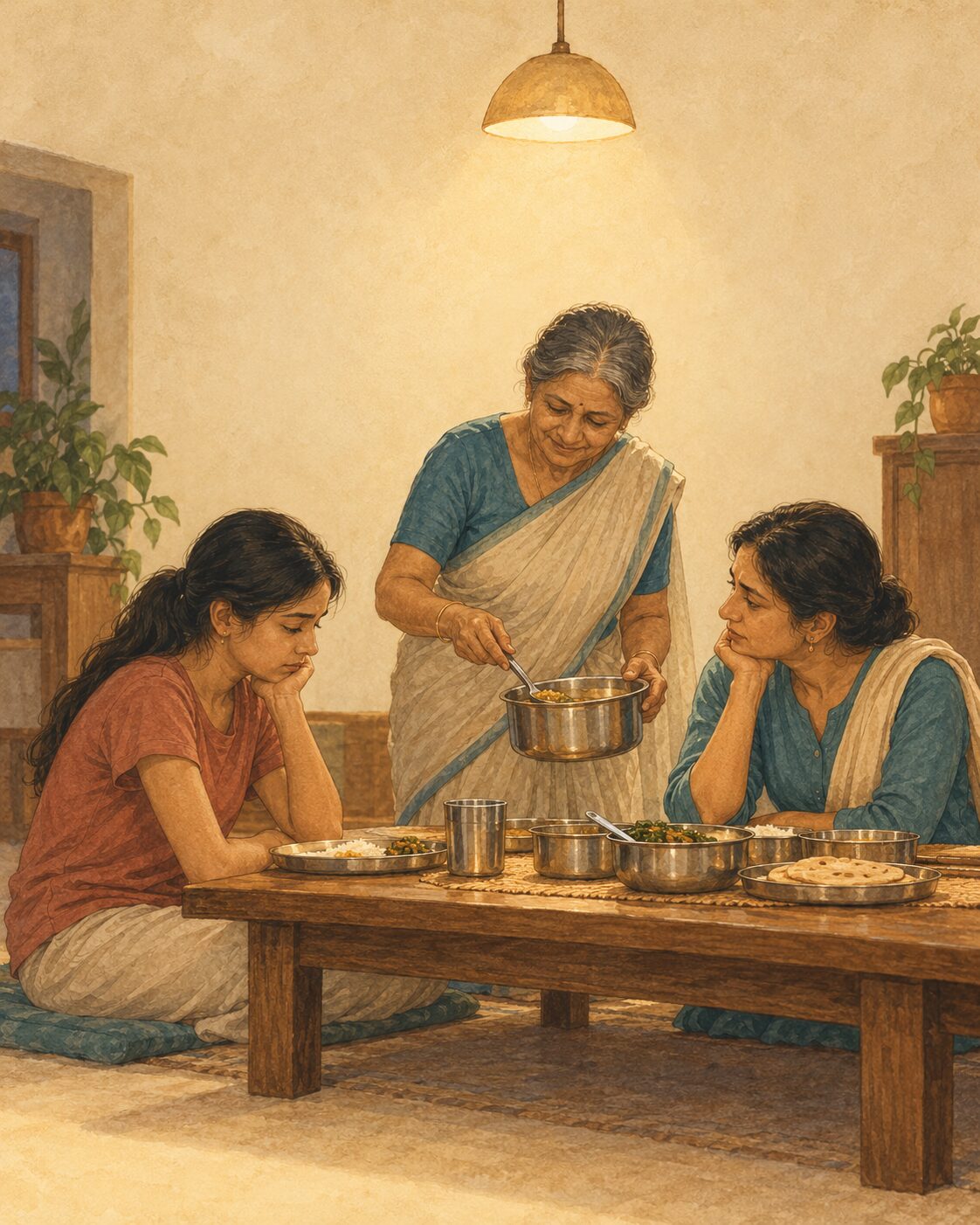
Kavita's daughter Riya is 15 and in Class 10. She is clever, careful and hard on herself. A few months ago a cousin teased her about her round cheeks. Riya began to "eat healthy", and at first everyone praised her. Now she cuts her chapati into tiny pieces and pushes them around the plate. She runs on the terrace every night, even when she is exhausted. Her grandmother says she is just being fussy. Kavita lies awake wondering what she missed.
She did not miss anything a loving parent should have caught. What Kavita is seeing has a pattern: fear around food, new rules, secrecy and a changing body. That pattern is a reason to see a doctor soon. It is not a reason for shame, and it is not something to wait out.
For the next few days, just notice and write it down. Which foods have dropped away? When are meals hardest? What does your child say about food or their body? Do not argue or correct yet. A short written record will help the doctor.
Not vanity, and not a phase
A hard relationship with food is a real mental health condition, and it needs care. Anyone can develop it, boys as well as girls. Many parents feel guilty, but good treatment does not blame the family.
Your child has come to use control of food to cope with feelings and other situations. From the inside, it can be frightening. Specialists describe terrifying, intrusive thoughts, and distress at meals that can be extreme. When your child fights you at the table, try to see the fear behind it.
The exact cause is not known. Some things make it more likely, such as anxiety, perfectionism and low self-esteem. A family history of eating problems, low mood or drug and alcohol use can play a part. So can pressure to be slim. You cannot fix this alone. But you can help a great deal.
I stopped fighting my daughter. I started standing beside her, against the illness.
Kavita, mother of Riya, 15
Boys get this too. Risk is highest in the teenage years, for boys and girls alike. Doctors are advised to ask boys about heavy training and exercise. So watch exercise rules as well as food rules. If they are taking over your son's life, take it as seriously as you would for a daughter.
In many of our homes the verdict comes fast. She is just fussy. He wants to look like a film hero. She will eat when she is hungry. Log kya kahenge, what will people say? These words are heavy, and they are wrong. Your child is not being stubborn. They are unwell, and with treatment most people can recover.
More, if you want it
Scolding, bribing and pleading are hard to resist when you are frightened. But guidance for families warns that showing anger and criticism is likely to make things worse. This does not mean you stand back. It means you work with the team, and aim your strength at the illness, not at your child. The next sections show you how.
The next time you feel angry at the table, swap the thought. Instead of "she is doing this to us", try "the illness is frightening her right now." Notice whether your voice softens.
Parents are part of the treatment
For young people, guidelines ask doctors to offer or consider family therapy focused on the eating problem. Early on, the team supports you to take a central role in your child's eating. Later, your child slowly takes back control.
Many parents expect a doctor to take their child away and fix this. Instead, the help that guidelines suggest first for young people works through the family. The name you may hear for it is family-based treatment. Over many months, a clinician meets your child and family, together and sometimes apart. In one trial with teenagers who were eating too little, both approaches helped. But at later check-ups, more had fully recovered with family-based treatment than with individual therapy. You are not the problem. You are a partner in your child's recovery.
- Get the body checked first, so you know your child is safe.
- See the illness, not the child, and stand together against the fear.
- Take charge of meals for now, calmly and kindly, as the team guides you.
- Hand control back slowly, as your child grows stronger.
Early on, the team helps you take a central role in your child's eating. Helping a child eat is not an everyday parenting skill. The team helps you build confidence with meal plans and with distress at meals. This role is for a season only. It is not a punishment, and it is not forever.
As your child gets stronger, the team helps them take back independence, at a pace that fits their age. The last stage plans for life after treatment, and for staying well. Recovery may take time, and it looks different for everyone. A hard week is a setback, not the end of progress.
Do not try to fix the food on your own. Work with the team, and make the changes it suggests. Rebuilding meals too fast, after a long spell of eating very little, carries medical risks. So a medical team guides it. The team will also check the body regularly. You bring the love and the steadiness. They bring the plan.
More, if you want it
You might start with one or two small changes. Some families find regular meal times together a helpful first step. Try to keep the talk at the table light, and about other things. If your child becomes upset, try to stay calm and seated. You do not need to win the argument. Follow what the team has shown you.
Remember
You are not fighting your child. You are fighting the illness, side by side with them. Say it out loud if it helps: "I know this is the fear talking. I love you, and I am not going anywhere."
With the team's agreement, choose one family meal each day to eat together, at the same time. Sit down, put the phones away, and talk about anything except food and bodies. Try it for one week before you judge how it is going.
What you say about food and bodies
Words about weight, shape and food matter a great deal here. Guidance for families says not to talk about diets, weight and shape with your child. Your home can be one place where bodies are not discussed.
Talk about food and weight is so common that it is hard to avoid. "You have put on weight." "This is fattening." "Look how slim your cousin has become." Being criticised about eating, body shape or weight can make this problem more likely.
So you might try a few simple swaps. Talk about food as food, not as good or bad, healthy or junk. Try not to praise weight loss, in your child or anyone else. Try not to criticise your own body in front of your child. Praise who your child is, not how their body looks.

Wedding season was the hardest time for Kavita's family. There were long buffets, many aunties and many comments. "Riya has become so slim, so pretty!" one aunt said loudly. Kavita saw Riya's face freeze. She had a line ready. "We do not talk about bodies in our family. Riya, come and help me find Nani." Later the two of them sat together for the meal, and Kavita kept the talk on the dancing.
More, if you want it
Before a wedding, a festival or a family visit, plan together. Agree on where you will sit and when you will eat. Pick a signal your child can use if it gets too much, and a quiet place to step away. Tell one or two close relatives what helps, briefly and in private. You do not owe everyone an explanation. "She is under a doctor's care, and we keep food talk off the table" is enough.
Write down two short lines you can use when a relative comments on your child's body or plate. Practise them aloud so they come easily. For example: "We do not comment on bodies in our family," or "Let us talk about something else."
You are carrying a lot
Caring for a child who is struggling with food is exhausting, and the fear you feel is real. Looking after yourself is not selfish. Guidance for families calls it vital.
Meals that used to be ordinary may now be the hardest hours of your day. You may feel fear at every plate, and guilt that you did not see it sooner. You may be grieving the easy child you had a year ago. None of this means you are weak. Looking after the parent is part of the care, not a luxury on top of it. Specialist guidance says families should be helped to look after themselves too, siblings included.
Your own body needs the basics too. Eat regular meals yourself, sleep when you can, and take short breaks. Share the mealtimes with your partner or another adult. It is hard to stay calm when you are worn out.
In a joint family the pressure can multiply. Elders may blame your cooking, your strictness or your softness. Some may want to keep it hidden. Others may push home remedies or a firmer hand. You do not have to win every argument. A short, steady line helps: "The doctor is helping us, and we are following a plan."
More, if you want it
Do not forget the other children in the house. Brothers and sisters may feel scared, ignored, or even jealous of the attention. A few honest words help: their sibling is unwell, the family is getting help, and they are still loved. Keep a little time just for them. Find one person on your own side too, a partner, a sister, a friend.
In your corner
On the evenings when a meal ends in tears, yours or your child's, hear this. A parent who reads a whole booklet to understand their child is not failing. You are standing beside your child through something very hard. That is love, and it counts.
This week, hand one mealtime to someone else, even just once. Ask your partner or a trusted relative to sit with your child for that meal. Use that hour for yourself, without guilt.
A doctor must check, and when it cannot wait
This problem can harm the body, even when your child looks well. Ask a doctor to check your child soon. Some signs need urgent medical help.
Struggles with food can be very hard on the body, and sometimes life-threatening. They can affect the heart, the blood, the bones and growth. You cannot judge the danger from how thin your child looks. A young person can look well and still be seriously unwell. Please do not wait for your child to look ill before you ask for help.
A good first step is your family doctor or a children's doctor. They can check your child's overall health and weight, and may refer you on. Good care usually joins several parts: family therapy, regular checks on physical health, and support for the family.
Remember
A good team looks at the whole child, not only the plate or the weight. They check the body, listen to your child, and treat you as part of the team. The plan is a conversation that gets adjusted over time. You stay part of every decision.
More, if you want it
You do not need every answer before the first visit. Bring your notes: which foods have dropped away, any exercise or bathroom trips after meals, and what your child has said. If your child refuses to come, you can go yourself first. A doctor can still guide you on the next step.
Most days, your job is to stay close and stay in touch with the team. But some signs mean the body may be in danger now. Young people can become medically unwell very quickly. Do not wait for the next appointment. Get urgent medical help, from a doctor or a hospital emergency department.
Fainting or feeling faint.
Especially fainting more than once.
Chest pain or breathlessness.
Or a heartbeat that feels very slow.
Very weak, very cold or confused.
Struggling to climb stairs or get up from a squat, a very low body temperature, or sudden confusion.
Rapid weight loss, or refusing food or drink.
Losing weight quickly, or stopping eating or drinking.
Some young people with eating problems have thoughts of ending their life. If your child talks about wanting to die, or about hurting themselves, take it seriously. Ask directly and calmly: "Are you having thoughts of ending your life?" Studies have found that asking about suicide does not increase suicidal thoughts. Stay with them and keep your voice low. Keep things they could use to hurt themselves out of reach. Tele-MANAS, on 14416, is a free government mental-health helpline, open day and night. If your child is in immediate danger, call 112 or go to the nearest hospital emergency department.
Recovery can take time. With help, and a parent on their side, many young people find their way back to the family table.
Write down the two or three changes that worry you most, with one real example of each. Save the Tele-MANAS number, 14416, beside them on your phone. Having both ready can make the first appointment, and any hard night, a little easier.
Where this comes from
This guide helps you recognise and understand. It is not a diagnosis. For that, see a professional.